
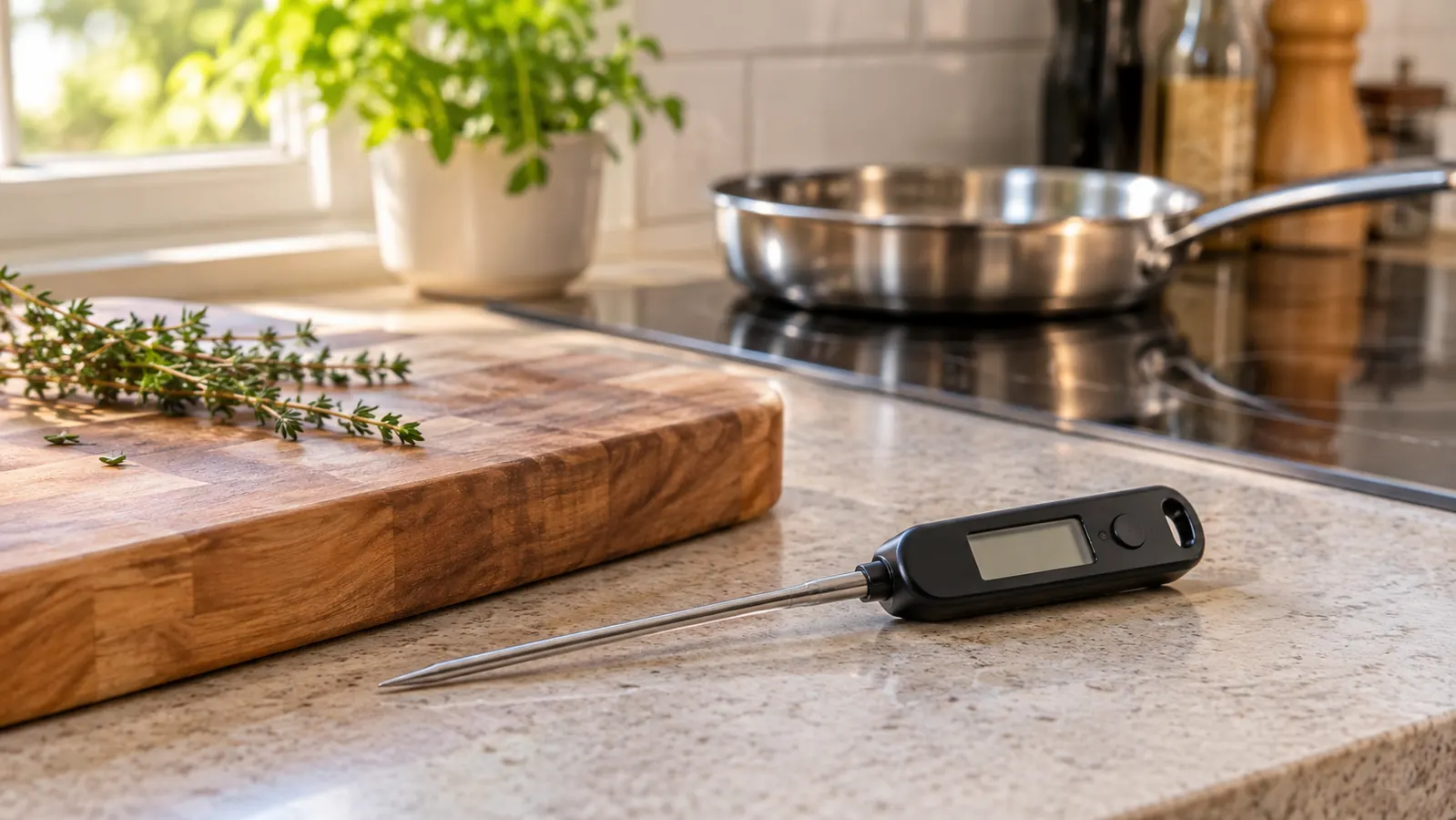
The dial thermometer I used for the better part of twenty years had exactly one setting I trusted: somewhere around done. I would push it into a pork loin, watch the needle swing past 145, wobble, and settle wherever it felt like settling, and then I would cut the roast open and find out the truth. That is a stupid way to cook, and I did it for decades without thinking much about it. When I finally replaced my worn-out gear in the first week of March, I bought the TempPro TP19H along with four other things, paid for all of it myself, and put the old dial in the junk drawer where it still sits. I have used the TempPro almost every night since.
This is not going to be a review that pretends everything is perfect. The TempPro is a good tool and I would buy it again, and it also has a listing that contradicts itself on the single number it advertises hardest, a probe depth worth understanding before you start, and a care instruction that means you cannot treat it like a pair of tongs. None of those are reasons to walk away. They are the things I would tell you over coffee at my kitchen table, so that is how I am going to write it.
The Quick Verdict
Fast, readable and boring in the best way. Every honest caveat lives in the fine print, not in the cooking.
Amazon Check Today's Price →The tool I reach for before I reach for anything else
One AAA battery in the box, a 2.0 inch backlit display that rotates to face you, and readings that settle before I can second-guess them. Check today's price on Amazon.
Amazon Check Today's Price on Amazon →How I've Used It Since March
The short answer is everything that has a temperature I care about. Chicken breasts on a Sunday, pork chops on a Tuesday, a small beef roast when the grandkids are not coming and it is just the two of us. I also check the center of a loaf of bread, which surprises people, but the difference between the middle of a loaf at 195 and the middle at 205 is the difference between a slice that holds together and one that does not.
Oil, too. I do not deep fry often, maybe once a month, but when I do I want to know where the oil is before the first piece of chicken goes in rather than after. And every few weeks I do the boiling water check, less out of doubt than out of habit from thirty-one years in a classroom. We sit at about 2,200 feet here in Asheville, so water boils nearer 208 than 212, and I use that number instead of the textbook one. The display lands within a degree of it every time.
The change I did not expect was social. Ruth used to ask whether the chicken was done and I would give her a look that meant probably. Now I give her a number. Dinner is quieter and the chicken is better, and I am honestly not sure which of those two things I like more.
The One Second Claim, and the Four Second Fine Print
Here is the part I would want someone to tell me before I bought it. The TempPro listing says, in the first of its feature bullets, that you get precise readings in just 1 second. Scroll down to the product attributes on that same page and there is a field labeled Response Time, and it reads 4 seconds. One thermometer, one page, two numbers, both printed by the company that built the thing.
I do not think either number is dishonest, and I cannot tell you which one is the fairer description of the tool in your hand. My guess, and it is only a guess from using it rather than from any inside knowledge, is that one figure is the moment the display first shows something and the other is the moment the reading has actually settled. What I can tell you is what happens at my counter. I insert the stem, count to myself, and pull it out, and the number I pull out with is the number I cook to. Whatever it is doing internally, it is doing it faster than any thermometer I have owned.
The same listing makes two claims I can actually test. Accuracy of plus or minus 0.9 degrees Fahrenheit, and a resolution of 0.1 degrees. The resolution is plainly real, because the digits move in tenths and I watch them do it. The accuracy lines up with what I see in boiling water. Speed is the only one of the three that asks you to take something on faith, and speed is the one the listing gives two answers for.
Does any of this matter when you are standing over a hot pan? Not really. It matters when you are comparing two listings at eleven at night with your reading glasses on, which is exactly what I was doing in February before I ordered. If you are that person tonight, you now know something I did not.
The battery that came in the box is still in the thermometer after eight months of nearly nightly use, and I have never once turned it on or off on purpose.
The Specification That Changes How You Use It
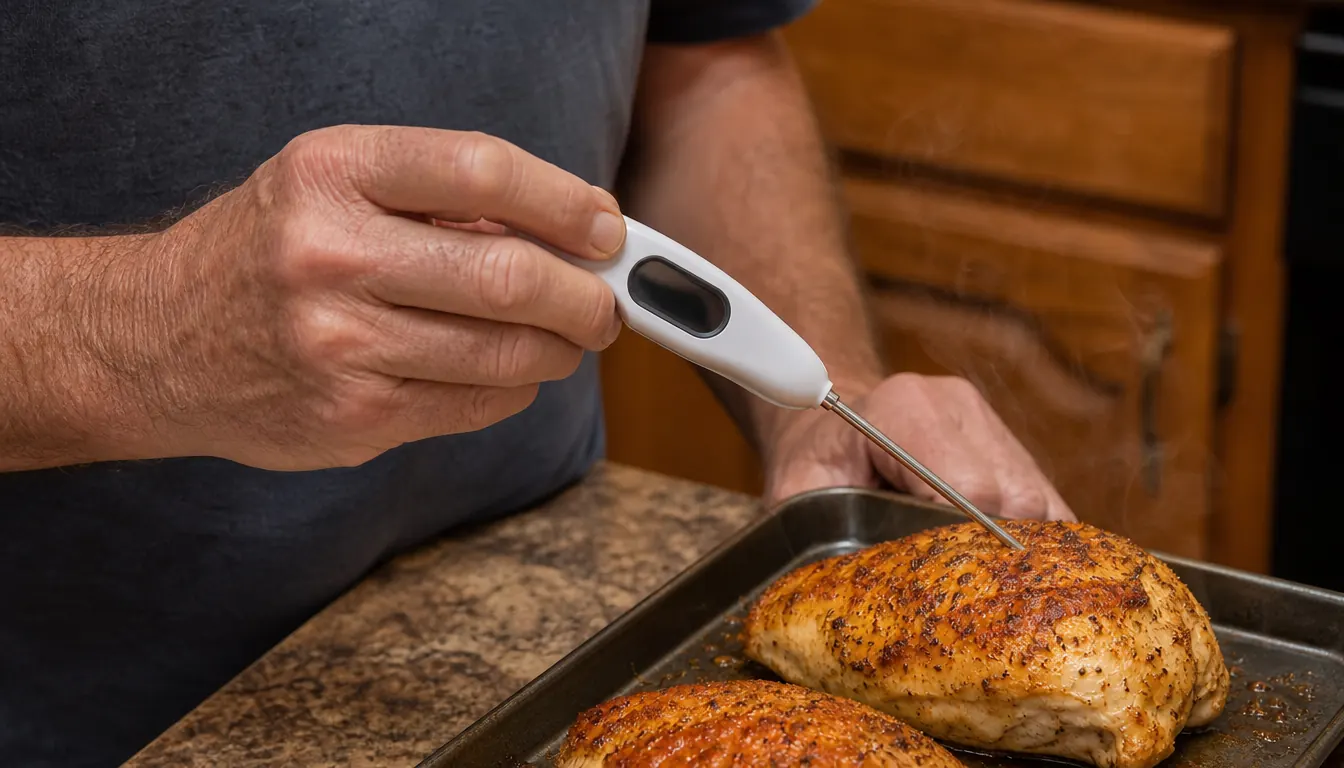
Immersion depth: 4.3 inches. Of everything in the specification table, this is the number that changed my cooking, and it is the one nobody mentions. It means the sensing section of the stem needs enough meat around it to be surrounded rather than merely touched. On a whole chicken or a thick pork loin that is no trouble at all. On a butterflied breast, a thin cutlet, or a thigh you have pounded flat, you have to think about the angle. Go in from the side rather than the top, keep the stem level, and aim for the center.
In my first month I got a reading of 190 out of a thin pork cutlet that I knew perfectly well was not at 190, because I had pushed the tip clean through the meat and into the hot pan. The thermometer was right and I was wrong. That is the failure mode with this tool and it is worth naming out loud, because it is the same failure you would have with any probe this long, and it will make you distrust a device that is working correctly.
Two more limits worth knowing. The upper temperature range is 300 degrees Celsius, or 572 Fahrenheit, so this is not the tool for candy work above that or for checking the surface of a pan that has been preheating for ten minutes. And the care field says hand wash only, though it also lists the unit as oven safe, which I read as tolerating oven heat for a moment rather than being left in there. I have not tested that difference and I do not intend to.
A Pork Loin That Used to Defeat Me
For fifteen years I made a pork loin that was fine and never better than fine, and I blamed the meat. The real problem was that I cooked to time and then cut into the roast to check, which meant the first two slices were always a test and everything after them was always slightly over. The first time I cooked one with this thermometer I pulled it at 140, tented it with foil, and sliced it without testing anything. Ruth said it was the best one I had made. It was the same pork loin from the same store.
That is not a thermometer making a cook better. That is a thermometer removing a variable so the cook can stop hedging. I had the same experience with chicken thighs, which I used to take to charcoal because the alternative was a pink center and a nervous dinner table. Now I check the deepest part once and I know.
Build, Battery, and What Eight Months Did to It
It weighs 77 grams, roughly the weight of a bar of soap, and that lightness is the reason I reach for it without thinking. It does not drag in a shallow pan or tip a small pot, and it does not feel like a piece of laboratory equipment I have to be delicate with. The outer material is food grade stainless steel, which is what you want on something that goes into meat and comes back out again.
The display is 2.0 inches and it rotates 180 degrees automatically. That sounds like a feature written by a marketing department until you are holding the unit at an awkward angle with your arm across your body over a hot pan, and then it stops sounding like one. It is backlit as well, which matters more at 63 than it would have at 40. I read it without putting my glasses on, and I will not pretend that is a small thing.
The battery deserves its own paragraph. One AAA, included in the box, advertised at up to 3,000 hours of use. I put that battery in during the first week of March and I have not replaced it. Nearly every night, eight months, still on the original cell. The listing also says the unit wakes when you pick it up and sleeps after a stretch of inactivity, and that matches exactly what I see. I have never switched it on or off on purpose, which is the highest compliment I can pay a kitchen gadget.
The listing also carries NSF certification, which is a food safety standard and not a sticker somebody designed in an afternoon. I notice that sort of thing because thirty-one years of teaching chemistry to teenagers left me with a low tolerance for claims that nobody is checking.

Bread, Oil, and the Cooks Who Do Not Eat Much Meat
I mentioned bread earlier, and here is why a fast read matters there. A loaf comes out of the oven and you have a window of a couple of minutes before the crust sets hard enough that a probe leaves a mark you can see. With the old dial I was already too late by the time the needle settled. With this one I am in and out while the loaf is still on the rack, and the hole closes back up as it cools.
Same story with a roast chicken on a Sunday. I used to pull it, carve it, and hope. Now I check the thigh, then the breast, then the deepest part of the thigh again. Three readings in the time the old dial would have given me one. Three readings is a different kind of confidence than one, and it costs me maybe fifteen seconds.
If you eat mostly vegetables and fish, this is still useful but you will not love it the way I do. The tool earns its place in the drawer through repetition on meat, bread and oil, and if your cooking does not run through those three, a cheaper thermometer would do you fine.
The Annoyances, Honestly
The auto-rotation occasionally settles at an angle I did not want, and I have to tilt the unit to get it to flip the right way up. Half a second of irritation, maybe twice a week. It is not a defect, it is a display doing exactly what the listing says it does, but nobody warns you that your wrist becomes part of the operation.
Hand wash only is the rule that genuinely bothers me. Everything else in my kitchen goes in the sink. This does not. If I am mid-rush with a raw chicken in one hand, the thermometer sits on the board until I can wipe it properly, and that is a small piece of friction in an otherwise frictionless tool. I wipe the stem with a soapy cloth, dry it, and put it back in the drawer by the stove next to the knife.
And the speed claim, which I have already complained about at length. Pick a number, TempPro. It can be four. Four seconds is still fast enough that I have stopped noticing it, and I would rather have a straight four than a proud one.
What I Liked
- Readings settle in about the time it takes to set the unit down, far quicker than any dial thermometer
- Plus or minus 0.9 degrees Fahrenheit accuracy that agrees with a boiling water check at 2,200 feet
- 2.0 inch backlit display with 180 degree auto-rotation, readable without glasses at an awkward angle
- One included AAA battery still running after eight months of nearly nightly use
- Light at 77 grams, so it does not drag in a shallow pan or tip a small pot
- 0.1 degree resolution, so you can see a roast climbing in real time
- NSF certified per the listing, and food grade stainless steel on the outside
Where It Falls Short
- The listing contradicts itself on speed: 1 second in the feature bullet, 4 seconds in the response time attribute
- 4.3 inch immersion depth means thin cuts need a deliberate insertion angle or you get a false high reading
- Hand wash only, so it cannot go in the sink with everything else
- Upper range of 300 degrees Celsius, which rules out very hot candy work and pan surface checks
- Auto-rotation sometimes settles upside down and you have to tilt it to flip
- It is a spot-check tool only, so there is no leaving it in the meat to monitor
Who This Is For
Anyone who cooks meat more than twice a week and has been guessing. Anyone still using a dial thermometer who does not realize how much of the uncertainty is coming from the instrument rather than from the cook. Anyone at an age where a backlit 2.0 inch display is a reasonable request rather than a luxury. And anyone who wants one tool that handles meat, bread and oil and lives in a drawer beside the knife, without needing to be charged or paired or updated.
Who Should Skip It
If you want a probe you can leave in the meat and watch from across the kitchen, this is not that. It reads when you put it in and you take it out. If you cook mostly thin cuts and cannot be bothered to think about insertion angle, a shorter probe will suit you better. If you want something you can throw in the sink with the dishes, this is hand wash only and it will not survive that habit. And if the one second versus four second mismatch is going to nag at you every time you open the drawer, buy something else, because I have now planted that thought in your head and it is not coming out.
Eight months, one battery, and a number I finally trust
The TempPro TP19H is the first thing I pick up on a weeknight and the last thing I put away. Current price and stock are on Amazon.
Amazon Check Today's Price on Amazon →