
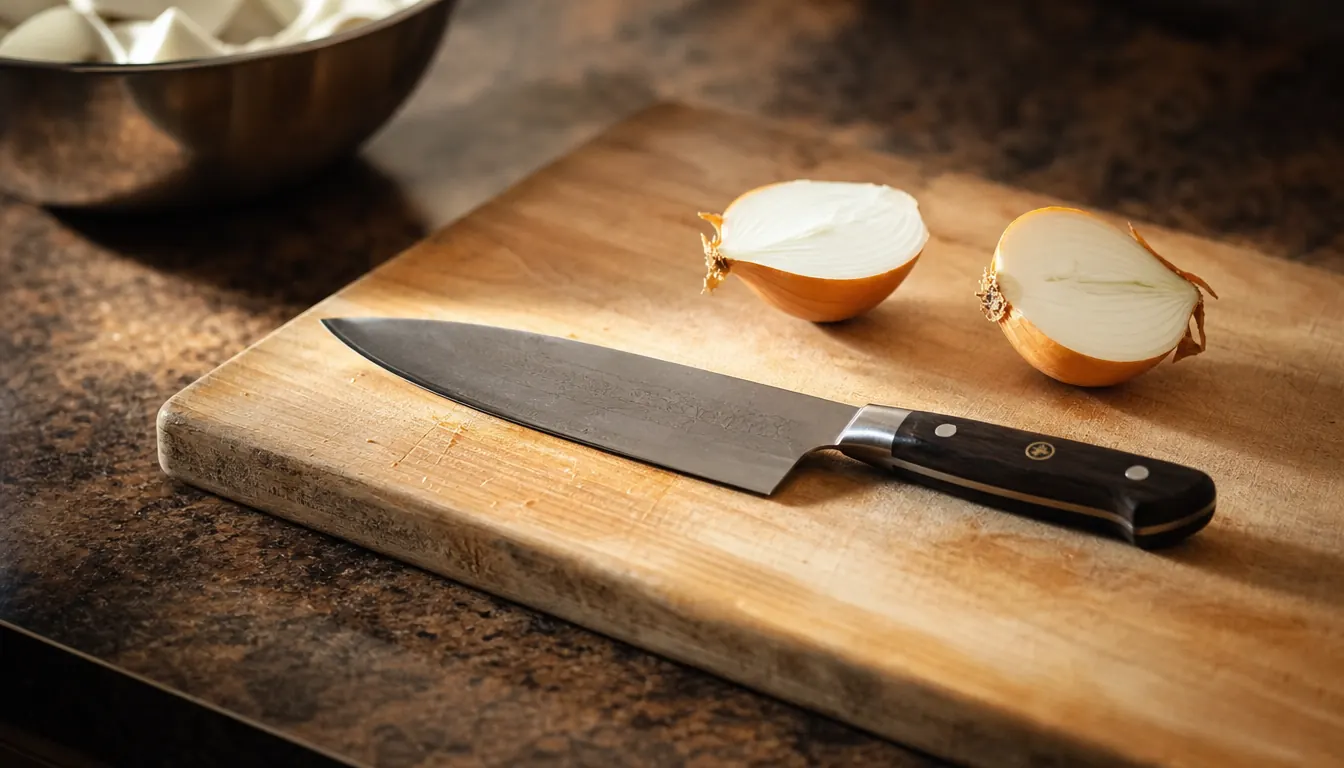
Twenty years is a long time to put up with a bad knife. My old set came from a department store, the kind sold in a wooden block with slotted cradles, and for two decades I told myself it was fine. It was not fine. Every onion was a small negotiation. The blade skated off the skin, I bore down, and the cut arrived late and slightly sideways. Carrots cracked instead of slicing. I blamed my hands, which seemed unkind given how often they had done the work.
When I retired after thirty-one years of teaching high school chemistry, I started cooking with more attention, and a few months of that was enough to show me the problem was never my hands. It was the steel. So in the first week of March I replaced the whole tired lot at once, with my own money, and the Victorinox Fibrox Pro 8 inch chef's knife was the first piece I chose. It is the one I have reached for almost every night since. Eight months of dinners now, somewhere around two hundred and forty of them, from a fast weeknight mince to a Sunday roast with two grandkids under the table. Nobody sent me anything to say. What follows is what I actually found, including the parts I did not love.
The Quick Verdict
A stamped, unglamorous workhorse that took an edge, held it through eight months of nightly cooking, and never once made me think about it.
Amazon Check Today's Price →Eight months of onions later, the edge still bites
The Victorinox Fibrox Pro is the knife that ended a twenty year argument between me and my cutting board. Check the current price and the size options before you decide.
Amazon Check Today's Price on Amazon →How I've Used It
Every honest knife review should start with the board, because the board is half the story. Mine is a maple butcher block, about eighteen inches by twelve, oiled twice a year and slightly dished in the middle from two decades of use. The Victorinox lives in a knife guard in the drawer to the right of my stove, which means it comes out and goes back perhaps twice on a heavy night. I hand wash it and dry it immediately, even though the listing says it is dishwasher safe. That is not a complaint about the knife. It is the habit of a man who once ruined a paring knife in a hot drying cycle and has not trusted a rack since.
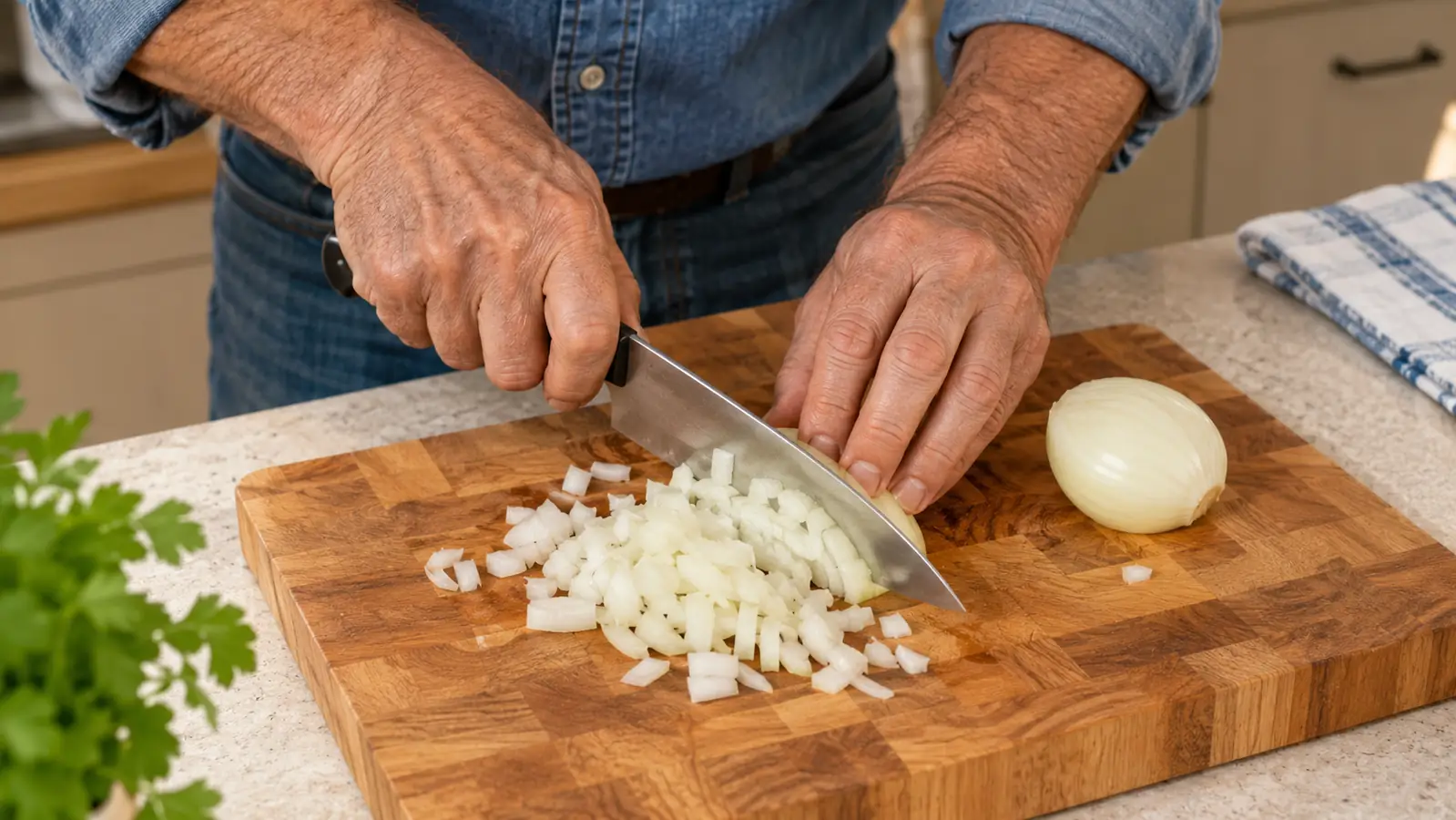
The blade is eight inches, thirteen point four inches end to end, and that proportion is the reason it feels quicker than it looks. On an onion it goes through the root end without the wobble I used to fight, and the tip is fine enough to make the horizontal cuts without tearing the layers. I dice an onion in about forty seconds now. It took me twice that with the old block, and I am not a faster man than I was in February. The same is true of herbs. Basil used to bruise under a dull edge and turn dark on the plate in ten minutes. Now it cuts clean and stays green until Ruth sits down.
Maintenance is where a knife either earns its place or becomes a chore you resent. This one is the former. I hone it on a steel I already owned, about once a week, five or six light passes per side, and that is the entire ritual. No stones yet, though I suspect I will want one eventually, and after eight months I can see the argument. I check the edge by slicing a tomato over the sink. The day it stops biting the skin without pressure is the day I learn to sharpen properly. That day has not arrived.
What a Stamped Blade Actually Gives You
Here is the part I find genuinely interesting, and it is where my old assumptions fell apart. This knife is stamped, not forged. A stamped blade is cut from a sheet of stainless steel rather than shaped from a single heated bar, and for most of my life I had absorbed the idea that forged was serious and stamped was the cheap stuff in the discount bin. What I had not thought through is what a thinner sheet of steel does at the cutting edge. It moves through material with less resistance. It also makes a lighter knife, which matters more at sixty-three than it did at forty, because fatigue in the wrist shows up as sloppiness long before it shows up as pain.
The blade is plain edged, no serrations, no scalloped dimples, straight through from heel to tip. It is stainless steel, which is what makes my careful washing habit optional rather than mandatory. Victorinox has been making blades since 1884, and there is a certain institutional confidence in a product that has not been redesigned into something fashionable. I like that. I do not need my knife to make a statement in a photograph. I need it to go where I point it, four hundred nights in a row, and not ask for anything.
One thing I would tell a buyer: ignore the sharper-than-everything claims you will read elsewhere, including mine. A new knife is sharp because it is new. What matters is what the edge looks like in month four, and how much work it takes to bring it back. Mine has been honed weekly and has needed nothing else. No chips, no rolled spot I could feel with a thumbnail, no change in the way it releases a cut. That is a modest achievement rather than a dramatic one, and modest is exactly what I want from a tool I touch every night of my life.
Eight Months of Edge Holding
Let me put the timeline down plainly, because vague praise is worthless. March through May, the knife was sharper than anything I had ever used and I was almost nervous with it. June through August it settled into what I think of as its working sharpness, still biting tomato skin, still shaving a thin slice off a potato without dragging, no longer quite the novelty it had been in the spring. September and October, still there, maintained only by the steel and ninety seconds a week. If you were hoping for a dramatic decline so this review had a plot, I cannot give you one. The plot is that nothing happened, for eight months, across roughly two hundred and forty dinners.
I have cut a great deal of garlic, more onions than I can account for, a butternut squash every other week through the autumn, and one memorable sweet potato that fought back. Squash is the honest test, because the skin is dense and the knife has to travel through on its own momentum rather than by force. I have never had to rock it through. I have also, being honest, scraped a few chopped piles off the board with the spine, which is the habit every careful cook tells you not to form. The edge has not punished me for it.
The honing steel came with the old block, and it is the one useful thing I kept from it. Five or six passes per side, angle judged by feel and by sound, which is a high clean ring when you are close and a dull scrape when you are not. I know a steel realigns an edge rather than restoring one, and I know a stone is in my future. Eight months in, the Victorinox has not asked for one. That is the whole maintenance story, and it takes less time than waiting for the kettle.
Two hundred and forty dinners, one borrowed honing steel, and the edge still bites tomato skin without pressure. Nothing dramatic happened, and that is the entire point.
The Handle and the Small Irritations
The handle is where most of the arguing about this knife happens, so here is mine. It is a textured synthetic grip, and the texture does exactly what it promises when your hands are wet, which mine frequently are because I wash as I go. It is not beautiful. Ruth, who has excellent taste and chose the colour of every appliance in this house, described it as looking like something from a school cafeteria, and she is not wrong. Looks are not nothing. But I have never once had it slip in a wet hand, and after thirty-five years of cooking I have learned to prefer boring grip over handsome grip.
Irritations, then, honestly listed. The blade is thin enough that a careless hand can flex it, and I have caught myself twisting slightly to free a stuck wedge of squash, which is a bad habit and not the knife's fault. The blade runs straight into the handle without a thick forged collar, so there is nothing to stop your hand drifting forward over long sessions. That has never bothered me, but a cook who spent years choking up on a heavy European knife will notice it on the first onion. And the flat of the blade is plain, so if you like a knife that scoops, this one does not scoop.
The listing carries a lifetime warranty against defects in materials and workmanship, and I have not had to test it, which is the best thing I can say about any warranty. It also says dishwasher safe. I believe it, and I still wash by hand, because heat and detergent are unkind to any edge and a dry towel costs nothing. Ruth does not cook much, but she notices when onions are cut to an even size, and she has noticed. Take that for what it is worth from a woman who will tell me plainly when something is not worth the counter space.
Where It Sits Against What I Owned Before
The old block is in a box in the garage now and I do not miss it. It had a carving knife I used twice a year and a paring knife that could not hold an edge past a single lemon. What I have learned is that one good eight inch knife does the work of eight mediocre ones, and that a knife you never think about is a knife you will use well. My son, who lives across town and cooks far more ambitiously than I do, owns a Mercer Millennia that I have handled in his kitchen. It is a good knife and I would not argue with anyone who prefers it. That comparison deserves its own piece, and it has one.
Who This Is For
This is for the home cook still fighting the block they bought in a previous decade, the one with the slotted cradle and the knives that skate. It suits anyone who wants to learn to cut properly and has realised that technique and a sharp edge are the same conversation, not two separate hobbies. It suits small kitchens, hand washing, weekly honing, and a budget that has to stretch, since the current price on this Victorinox is a fraction of what the famous names ask. It suits wrists that have started to complain, because the lighter weight is not a compromise you notice. It is a relief you notice.
Sunday dinner is the test I care most about, because that is when the grandkids come and the kitchen gets loud. I break down a chicken, cut potatoes, and have everything on the board at once. Two years ago that was a scramble with two knives and some language I would rather not repeat in front of a nine year old. Now it is one knife, one board, and a small person asking why the onion makes her cry. I mention it because that is the actual job. Not the test kitchen job. The Tuesday job and the Sunday job.
Who Should Skip It
Skip it if you want a knife that looks like an heirloom on an open magnetic strip, because this one will never be that. Skip it if you are devoted to a heavy forged blade and the way it falls through a carrot under its own weight, since this one is light and you will feel that difference immediately. Skip it if you never hone or sharpen anything, because even good steel goes dull and no purchase fixes neglect. And skip it if you want the knife to be the hobby rather than the tool. This is a knife that disappears into the work, and some people, quite reasonably, want a beautiful object in their hand instead. Neither of us is wrong.
What I Liked
- Held a working edge through eight months of nightly cooking with nothing but a weekly honing
- Light in the hand, which mattered more to me at sixty-three than it would have at forty
- Textured synthetic handle grips reliably when hands are wet
- Eight inch blade with a fine tip handles onions, squash, herbs and proteins without a second knife
- Stainless steel and listed as dishwasher safe, with a lifetime warranty against manufacturing defects
Where It Falls Short
- Plain flat blade does not scoop chopped food the way a curved one does
- No forged collar between handle and blade to stop your hand drifting forward
- Thin blade can flex if you twist it while freeing something dense
- Utilitarian looks that will never impress anyone on a magnetic strip
- You will eventually need a stone, and the knife will not tell you when
One knife instead of eight, and a board that finally behaves
If your block is still full of knives that skate, this is the replacement that ends the search. Check today's price on the eight inch Victorinox Fibrox Pro.
Amazon Check Today's Price on Amazon →