
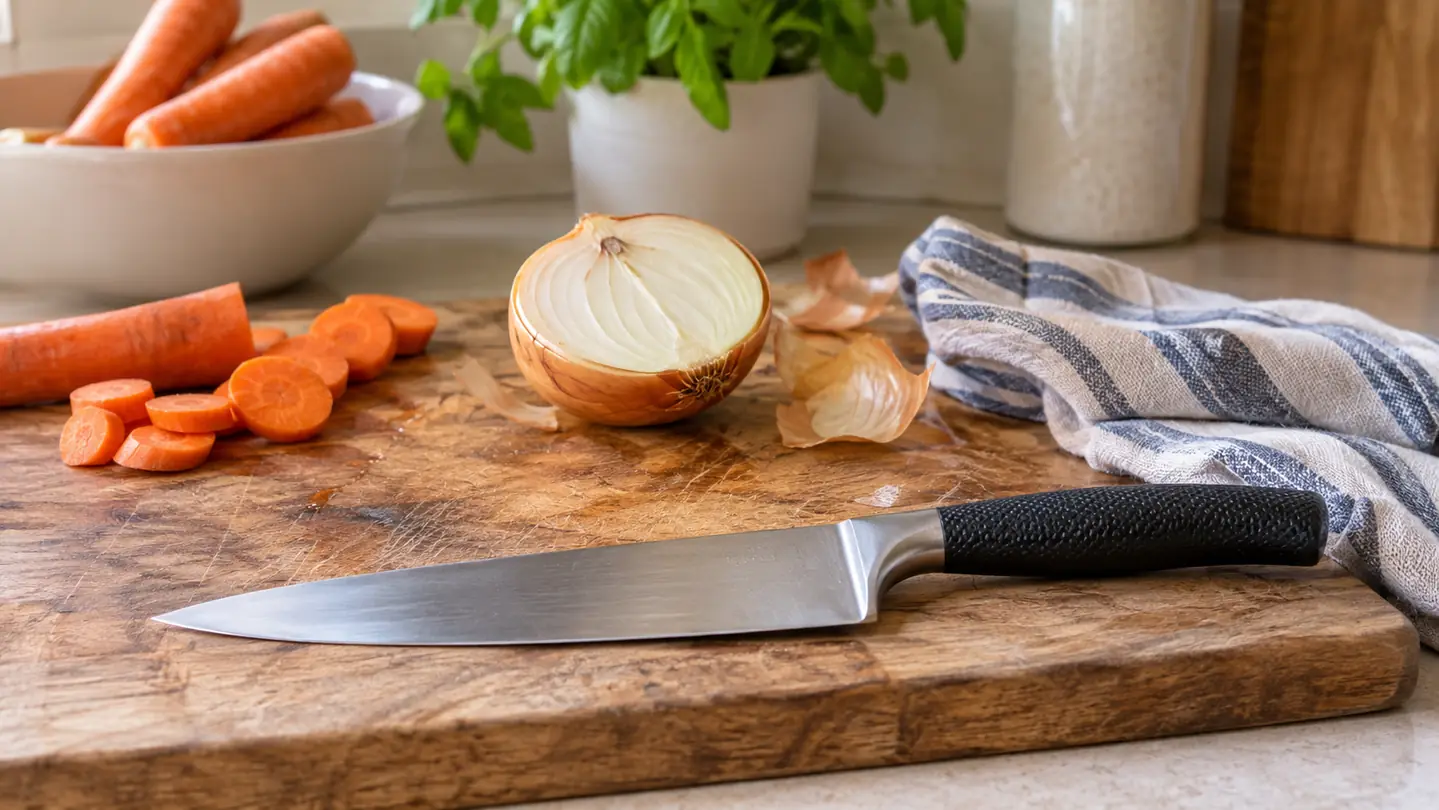
I own exactly one chef's knife. It is the Victorinox Fibrox Pro, the 8 inch stamped knife I bought in the first week of March when I finally admitted that the department store block on my counter had been dull since the Clinton administration. My son owns the Mercer Millennia. I have used his a handful of times in his kitchen, usually while being told to sit down and let somebody else cook for a change. So this is not a laboratory comparison. I have lived with one of these knives for about eight months, and I have handled the other enough to know how it behaves in the hand.
Here is the short answer, and then I will show my work. If you want one knife to do nearly everything for a long time and you would rather buy once, the Victorinox is the one I would put in your hand. If you are outfitting a first apartment, a camper, a cabin, or a kid heading off to school, the Mercer does that job well and costs less to be careless with. Both are stamped blades in the budget tier. Both will get you through a pile of onions. The differences that matter are the handle, the edge, and what the knife is like two years from now.
| Victorinox Fibrox Pro | Mercer Millennia | |
|---|---|---|
| Price tier | Budget tier, check today's price | Budget tier, usually the cheaper of the two |
| Blade construction | Stamped stainless steel, 8 inch blade, 13.4 inches overall | Stamped stainless, 8 inch blade |
| Handle | Textured grip, listed as dishwasher safe | Smoother molded grip |
| Grip with wet hands | Stayed put through a wet bag of potatoes | Shifted slightly in my hand more than once |
| Edge out of the box | Sharp new and thin behind the edge | Sharp new |
| Edge holding over a week of dinners | Holds with a few passes on a steel | Wanted the steel sooner in my time with it |
| Warranty | Lifetime warranty against manufacturer's defects | Limited lifetime warranty |
| Loan it out without flinching | I hand wash mine and keep it in a guard | Goes in the dishwasher at my son's house and nobody worries |
| Buying a second one or a matching set | Full line from the same maker | Restaurant supply standard, sold in bulk everywhere |
| Best for | One knife used nightly for years | A first knife, a spare, a knife that travels |
How I Ended Up Cooking With Both
The Victorinox came into the house the way most of my gear does these days, as a replacement for something that had stopped doing its job. The old block had knives that would not hold an edge past a single dinner, and I had been honing them out of stubbornness rather than hope. The Fibrox Pro arrived in the first week of March and has been on the butcher block almost every night since. The listing carries a 4.8 star average across more than fifteen thousand reviews, which is exactly the kind of number that makes me suspicious, so I read a hundred of them before I ordered. What surprised me was how many came from people who cook for a living.
The Mercer I did not buy. My son has one in his kitchen, and I have used it there. He is a decent cook who does not sharpen anything and does not own a honing steel, which makes his kitchen a fair test of a knife that has to fend for itself. I have cut onions with it, broken down a chicken with it, and wiped it down and put it back in his drawer. That is not eight months of ownership. It is enough to form an opinion, and I will tell you plainly where my opinion is not firm.
A word about what these knives actually are, because I taught chemistry for thirty one years and I cannot help myself. Both are stamped. A stamped blade is cut from a sheet of steel, ground, edged, and then fitted to a handle. That is not a compromise at this price, it is how the price is possible, and some genuinely good knives are made that way. Forged knives are heated and shaped with a bolster at the heel, and they cost more for reasons that have as much to do with labour as with performance. What decides how a knife cuts is the steel, the grind behind the edge, and whether the handle fits your hand. Everything else is preference dressed up as physics.
If you are earlier in this than I am, here is the part I wish someone had said to me at forty. A chef's knife is the tool you will touch more than any other in the kitchen, and the difference between a good one and a bad one is not a matter of taste. It is the difference between wanting to cook on a Wednesday and finding an excuse not to. I spent twenty years with knives that made the work harder and assumed that was simply what cooking felt like. I do not recommend it.
Where the Victorinox Wins
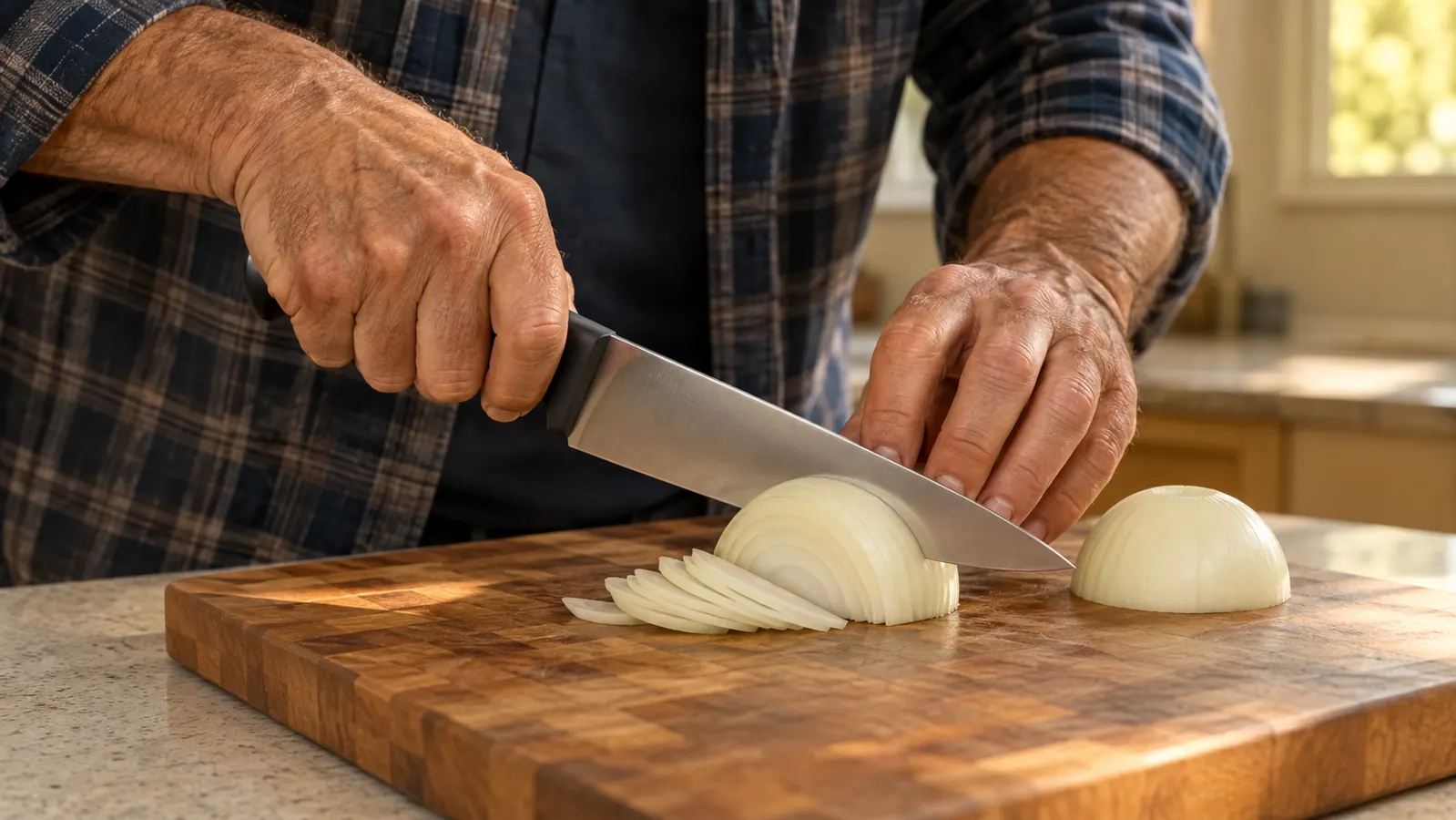
The handle is the reason this knife has the reputation it has, and it took me about a week to understand why. It is textured, with a slight give to it, and it does not care whether your hands are dry. On a Tuesday in April I was rinsing potatoes and chopping them in the same motion, hands wet the whole time, and the knife never moved in my grip. My son's Mercer has a smoother handle. Twice in one evening, working through a pile of onions at his counter, I felt his knife rotate a little in my hand. It never slipped out. But I noticed, and after twenty minutes I noticed that I was gripping it harder than I grip my own.
The second advantage is the grind. The Victorinox is thin behind the edge, which is the part nobody talks about and the part that decides whether an onion falls apart or gets shoved around the board. I hone mine once a week on a steel I have owned since the nineties, five or six light passes, and it holds through a week of dinners. The Mercer is genuinely sharp. It is not a dull knife and I will not pretend it is. But in my limited use it wanted the steel sooner, and two passes brought it right back, which tells you the steel is fine and the edge angle is doing its job.
A practical note on size, since this is the sort of thing that gets left out. The blade is 8 inches and the knife measures 13.4 inches overall. That fits a standard drawer with room to spare and does not crowd a small board. I have about eight feet of laminate counter and one butcher block, and a longer knife would have me turning the board sideways to use it. My son's knife is the same nominal size, so this is not a point in either column. It is a point against the 10 inch knife a lot of people buy first and then quietly stop reaching for.
Then there is the part you cannot feel in a shop. The listing gives a lifetime warranty against manufacturer's defects and names Switzerland as the place of manufacture. I have never had to test that warranty, so I will not claim it is easy to use. But a company that will stand behind a kitchen knife for life is telling you something about how many it expects to come back. The other thing is consistency. When I recommend a knife to a friend, I want to know that the one they order is the one I own. Eight months of reading reviews on this knife suggests that it is.
Where the Mercer Wins
The Mercer wins on cost, and there is no honest way to write this comparison without saying so plainly. It is cheaper, it is easy to find, and it is the knife culinary programs hand to students because it is inexpensive enough to replace and good enough that nobody is held back by it. If you have ever flipped through a restaurant supply catalog, you have seen the Millennia line spread across half a page. My son bought his on the way home from work one evening. That is not a knock. That is a knife doing exactly what it was designed to do.
And here is the argument for a cheaper knife that is still a good knife: it frees you. I hand wash and dry the Victorinox after every use even though it is listed as dishwasher safe, and I keep it in a guard in the drawer to the right of the stove, and I am aware of it in a way I am not aware of a spatula. At my son's house the Mercer goes in the dishwasher, comes out fine, and nobody thinks about it again. If you cook with grandchildren underfoot, or you pack a knife for a cabin weekend, or you want something in the block that guests will use, that freedom is worth real money.
The last concession is feel. His knife sits a little heavier in my hand and carries more weight out toward the tip. Some cooks prefer that, especially on dense vegetables, because the blade does part of the work for you. I do not. I have small hands and thirty five years of a grip I am still correcting, and the lighter feel of the Victorinox suits me better. That is preference, not performance, and you should weigh it as such rather than letting me decide it for you.
Eight months, one knife, one honing steel, and I have not once wished I had bought something else.
The Part Nobody Mentions: Upkeep
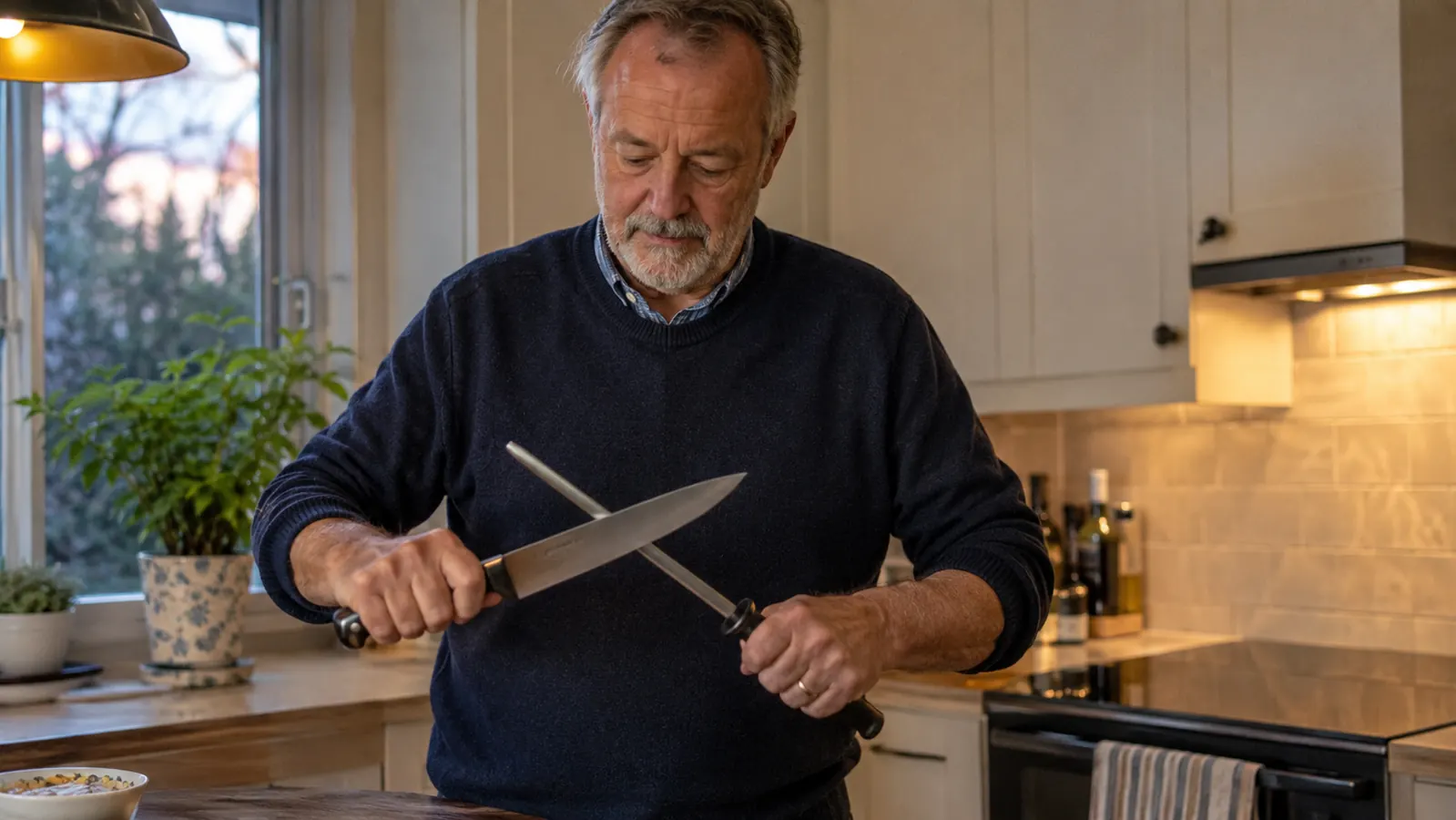
Both of these knives are listed as dishwasher safe, and I would not put either through a dishwasher on a regular basis if I could help it. Heat and detergent are hard on a handle over years, and a knife knocking against other dishes loses its edge while it sits there. My routine takes about forty seconds: wash it by hand, dry it, five passes on the steel once a week, back into the guard. If that sounds like a chore, it is not. It is just what a knife needs. The Mercer gets far less attention at my son's house and is still fine after a couple of years, which tells you it is a durable knife. It does not tell you that neglect is free.
The one thing I would tell anyone buying either knife is to spend a little attention on sharpening, because a dull knife is more dangerous than a sharp one. A sharp knife goes where you point it. A dull one skids off an onion skin and into a finger, and I have the scar to prove it. I sharpen mine twice a year on a stone, which is more than most people bother with, and if you never learn that, a simple pull-through sharpener will get you most of the way there. Neither of these knives is precious. Both are tools. The Victorinox has simply been the tool that needed less correction.
The knife I reach for every single night, at today's price
Eight months of dinners, one honing steel, and the same edge angle out of the box as the day it arrived. If you want one chef's knife that will outlast the block it sits in, start here.
Amazon Check Today's Price on Amazon →Who Should Buy Which
Buy the Victorinox if you are replacing a worn out knife and you intend for the replacement to be the last one for a while. Buy it if you cook most nights, if your hands get wet while you work, if you want the same knife every time you order one, and if a lifetime warranty against manufacturing defects is worth something to you. It is the knife I would hand my own daughter tomorrow if she asked, and it is the knife I would buy again without reading a single review if this one walked out of the drawer.
Buy the Mercer if the knife is going into a rental kitchen, a first apartment, a boat, a camper, or a kitchen where things get lost and borrowed. Buy it if you are outfitting someone young who has not yet decided that a knife is worth caring about. Buy two, so there is always a clean one. And buy it if you tried the Victorinox and found the handle too grippy or the blade too light, which are real preferences and not defects in either knife. Both will cut your dinner. Only one of them will make you want to keep it for twenty years, and by now you can probably guess which.
One knife, used nightly, still holding its edge
The 8 inch Fibrox Pro is what survived my old knife block, my learning curve and eight months of dinners. Check today's price and see whether it earns a spot on your board.
Amazon Check Today's Price on Amazon →