
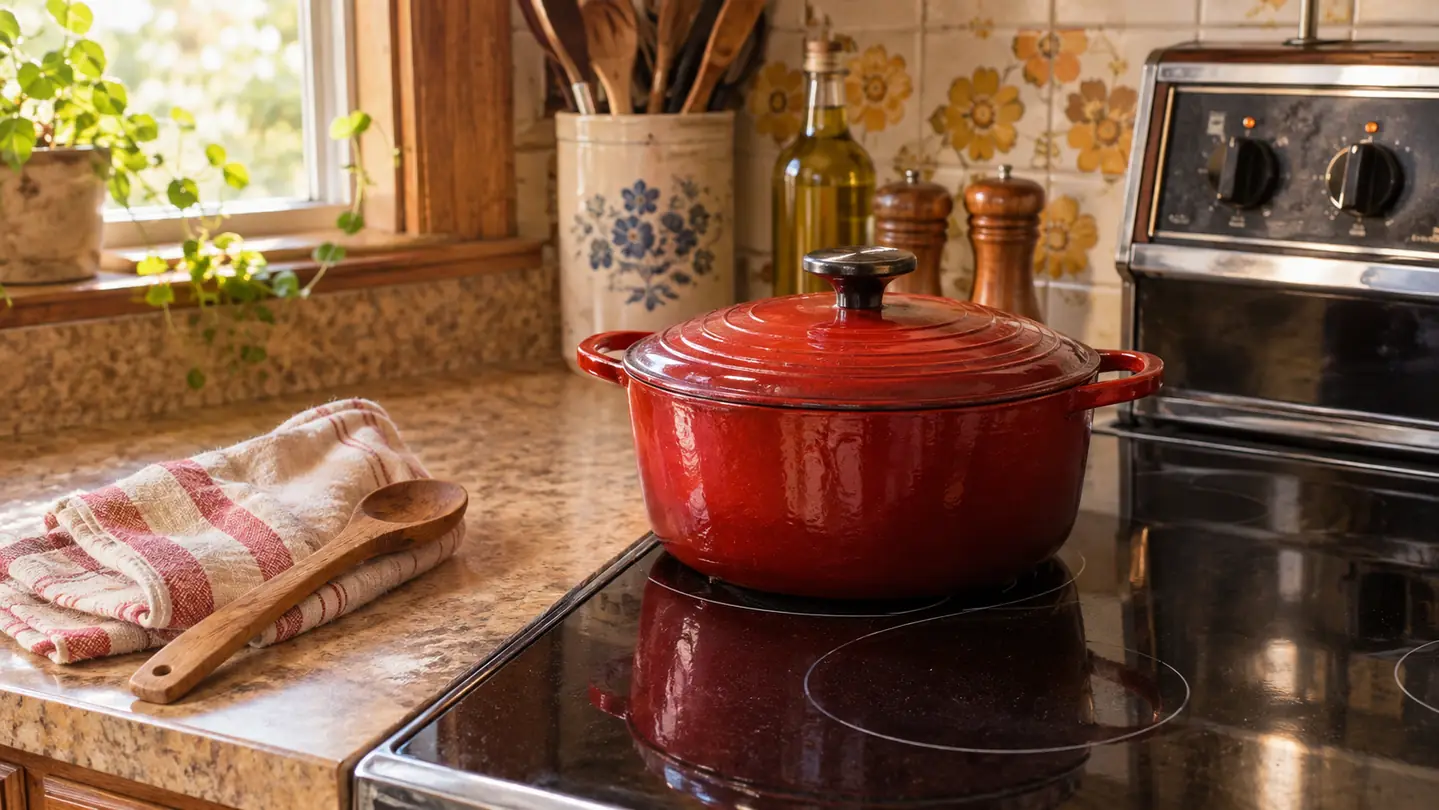
I ruined a three and a half pound chuck roast in early March, and it taught me more about cookware than anything I read beforehand. It went into a thin stainless stockpot at 325 degrees for four hours and came out tasting like the bottom of a coffee pot. The meat was fine. The sauce was scorched. Somewhere in that last hour the liquid went from a simmer to something worse and the pot never told me, because a thin pot has nothing to say. Three days later I bought the Lodge Essential Enamel 6 quart Dutch oven, along with four other pieces of gear I had been putting off for years, and I have cooked in it two or three times a week ever since.
That is eight months now. Sunday dinners, weeknight chili, chicken thighs, lentil soup, and about a dozen loaves of bread. Not a week of testing with a photographer standing over me. I am not a chef. I taught high school chemistry for thirty-one years, I cook dinner most nights in a 1970s kitchen with an electric glass top range, and I care about why things work. So this is what ordinary use looked like, including the part where I chipped it.
The Quick Verdict
Holds a steady simmer without being watched, browns evenly at medium heat on an electric glass top, and the cooking surface is unchanged after roughly ninety sessions. It is heavy, it is hand wash only, and my wife will not lift it full.
Amazon Check Today's Price →The pot that turned my worst braise into my Sunday standard
Six quarts, enameled cast iron, oven safe to 500 degrees. Eight months of near-daily cooking and it is still the piece I would replace first if it vanished.
Amazon Check Today's Price on Amazon →How I've Used It
It lives on the back left burner, which is also where it stays when it is not in use, because I got tired of lifting it in and out of a cabinet twice a day. My range is an electric glass top, not gas, not induction, and that shapes how I cook with it. I use medium heat and I lift the pot on and off rather than sliding it, a habit I picked up in the first week and have not broken. I am not going to tell you the manufacturer blesses that on a glass top, because I do not know that and neither does anyone quoting a product listing. I know what I do, and I know what the surface of my range looks like after eight months.
A typical week: Sunday a braise, usually beef or pork shoulder, three to four hours in the oven at 325. Tuesday or Wednesday something faster, chicken thighs seared on the stovetop and finished in the oven, or a pot of chili that starts with dried chiles toasted in the same pot. Friday occasionally a loaf of no-knead bread, with the empty pot preheating at 450 for half an hour first. Nothing about that schedule is unusual. That is the point. I am not putting the pot through anything a normal household would not.
The Sunday habit got specific in a hurry. On the second Sunday in March I put a 3.9 pound pork shoulder into the Lodge with a cup and a half of cider, set the oven to 325, and checked it at three hours expecting to need another one. It was done. The next week, out of pure stubbornness, I cooked the same cut the same way in the old stockpot. At four hours it was still tough and the liquid had gone the wrong direction, which is to say it had mostly left. That was the last time I ran the comparison.
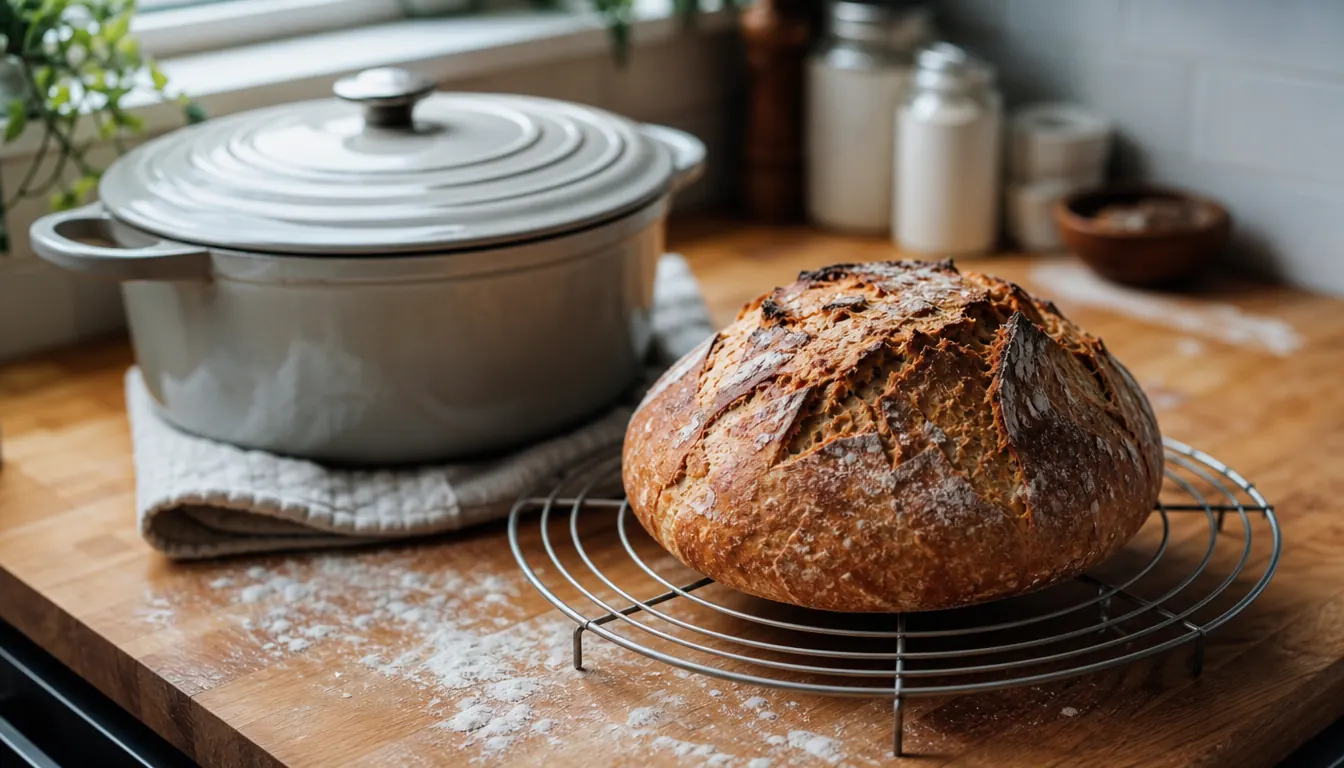
The bread is what surprised me. I had read that enameled cast iron bakes well and I half believed it, the way you half believe anything you read about cookware. The first loaf came out with a crust my baking stone never produced, and I have made one roughly every two weeks since April. The pot goes from a 325 degree braise on Sunday to a 450 degree oven on Friday without complaint, which is more range than I expected from one vessel.
The change I did not expect is that it made me a calmer cook. The pot holds heat so steadily that I stopped hovering over the burner. With the stockpot I was adjusting the flame every ten minutes because I could hear the liquid going from a murmur to a rattle. With this one I set it and walk away, and the simmer stays a simmer. That sounds like a small thing. It is the whole thing. A braise is mostly a patience test, and this pot passes the test for me.
The Enamel Surface, Eight Months In
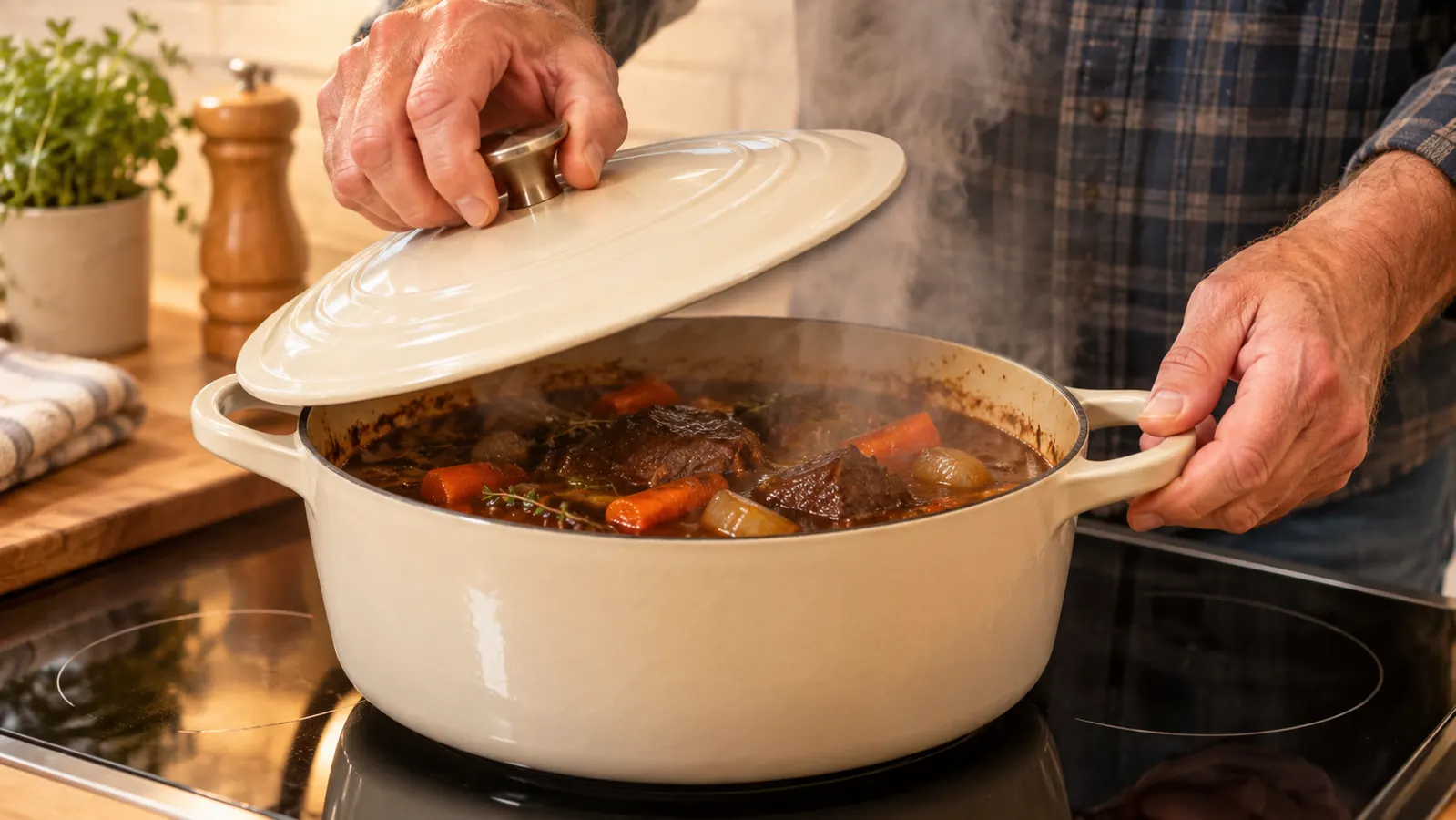
The inside is the part that matters, so let me be exact. After eight months of two or three uses a week, somewhere around ninety cooking sessions, the cooking surface is unchanged. No staining that survived a soak, no dulling, no crazing, no patch where something stuck and took the finish with it. I have made tomato sauce in it about a dozen times, which is the classic stress test for enamel, and there is no grey patch where the sauce sat.
One episode is worth reporting, because it is exactly the kind of thing that makes people nervous about enamel. In May I made a chili with three tablespoons of smoked paprika and left it in the pot overnight because I was tired and lazy. By morning the interior was a deep orange brown and I assumed I had finally ruined something. Warm water, a spoonful of baking soda, twenty minutes, and it came off in a single pass with a soft sponge. No ring, no shadow, no dull patch where it had sat. I had read that enamel holds color. Mine did not, at least not at that concentration.
The outside has one mark. In the first month I swung the rim into the kitchen faucet while carrying it to the sink and took a chip out of the outer enamel. It is about the size of a grain of rice. It has not grown, it does not affect cooking, and I notice it roughly once a month. It is also a fair warning about what this object is: a heavy enameled pot that does not enjoy being knocked into chrome. I am the reason it chipped. The pot did nothing wrong.
The care instructions that came with the Lodge say hand wash only, and I want to be honest that this is a real cost rather than a footnote. Fifteen minutes, mostly soaking, a soft sponge, then dry it and put it away. I have never needed anything abrasive. The one time I burned sugar into the bottom making a glaze, a thirty minute soak in warm water lifted all of it without scrubbing. But if the idea of a pot that cannot go in the dishwasher irritates you, that irritation will not fade with familiarity. It will just be there every Sunday.
Heat, Weight and the Electric Glass Top
It weighs 13.5 pounds empty. That number decides whether you like the pot or resent it. Empty, I move it without thinking. Full of a four pound braise and two quarts of liquid it is closer to twenty pounds, and Ruth, who is sixty-one and has a librarian's wrists, will not carry it from the stove to the sink. She says so cheerfully and hands me a towel. I do the carrying in this house, so the weight has been a manageable fact rather than a daily grievance.
The dimensions are honest too. About 13.25 inches across the handles, 6 inches tall, roughly 11.6 inches at the body. Six quarts sounds enormous until you are trying to brown four pounds of chuck in it, and then you learn that anything past about two pounds at a time steams instead of browns. I do beef in two batches now. Crowding the pot was the most common mistake I made in the first two months, and it took one grey, watery batch of short ribs to fix the habit permanently.
I measured the capacity once, out of curiosity and because thirty-one years of teaching chemistry left me unable to leave a volume unmeasured. Filled to about an inch below the rim it takes a hair over five quarts of water, which makes the six quart rating generous rather than inflated, and it means a big batch of soup for the grandkids still leaves a margin below the lid. I also checked the heat that first month, just to see: a bare simmer sat between 195 and 200 degrees and stayed there for forty minutes without my touching the burner. My stockpot swung twenty degrees in the same window, and I could hear every one of them.
Oven safe to 500 degrees, which is more than I need. My bread bakes at 450 and the braises never go past 350. The lid sits down into the rim and holds moisture well enough that a three hour braise loses very little liquid, which is why the same recipe that dried out in my stockpot now finishes with a proper sauce instead of a crust. There is no sensor on it, no dial, no display, nothing electronic to fail in five years. It is a pot. After a career spent around instruments, I find that restful.
Where It Fell Short
The weight is the main one and I will not dress it up. Lifting a full six quart pot out of a hot oven with two towels is the least pleasant thirty seconds of my Sunday. If you have shoulder or wrist trouble, this design, and frankly any design like it, is going to be a negotiation every single time you use it. That is not a flaw Lodge could engineer away. It is what cast iron is.
The second is browning capacity. Six quarts of volume does not mean six quarts of searing surface. The base is wide but not as wide as a skillet, and I get better results browning short ribs in my old 12 inch stainless skillet and then moving them into the pot to braise. That is two pans to wash instead of one, and I do it anyway on the days it matters. On a Tuesday I skip it and accept a paler sauce.
The third is the outside enamel. It is durable enough for eight months of my kitchen, but it is glass fused to iron, and glass chips when it meets something harder than itself. Mine did, in month one. If you want a pot you can treat carelessly, this is not that pot, and no enameled pot is.
What It Does Better Than My Old Pot
Heat retention, obviously, but the specific benefit is fond. My stockpot had a thin disc bottom that went from nothing to scorching in about ninety seconds, so anything I seared left behind a bitter black layer instead of a brown one. This pot comes up to temperature slowly and then stays, so the fond builds evenly and stays usable. Fond is the browned crust left on the bottom after searing, and it is most of the flavor in any braise. I was throwing it away before without knowing it. Now I deglaze with a cup of stock or wine and scrape it back into the sauce.
The second thing is moisture control, which comes down to the lid. Heavy, enameled, seated into the rim. A four pound pork shoulder goes in with a cup and a half of liquid and comes out three hours later with a sauce that needs reducing rather than rescue. That single change is why the pot earned its place on the burner instead of in a cabinet. My old setup produced dry meat and thin sauce from the same recipe, and I spent two years blaming the recipe.
What I Liked
- Holds a steady simmer without watching, which is the difference between a braise and a scorched pot
- Even browning and usable fond at medium heat on an electric glass top
- Cooking surface unchanged after roughly ninety sessions, including a dozen rounds of tomato sauce
- Oven safe to 500 degrees, so it handles Friday bread at 450 without complaint
- Six quarts covers a family dinner plus two days of leftovers
Where It Falls Short
- 13.5 pounds empty and closer to twenty when full, so it is a two-handed lift every time
- Hand wash only, and no amount of practice makes that faster
- Outer enamel chips if you knock it into something hard, as mine did in month one
- Will not brown more than about two pounds of meat at once without steaming it
Roughly ninety cooking sessions, a dozen of them with tomato sauce, and the cooking surface has not stained, dulled or crazed. The only mark on the pot is the one I put there with a faucet in month one.
Who This Is For
The home cook who makes braises, soups and chili on a regular basis, on a stovetop that is not gas, and who wants one vessel that goes from burner to oven without a second thought. If you have been making do with a thin stockpot and quietly wondering why your pot roast comes out dry and your pan sauces taste flat, this is the upgrade that fixes it. It suits a bread baker too, since the same pot that braises a shoulder at 325 will bake a loaf at 450. Of everything I bought in that March spending spree, this is the piece I would replace first.
Who Should Skip It
Anyone with wrist, hand or shoulder problems should think hard before buying, because a full pot is heavy and there is no version of this that is not. If you cook for one or two and rarely make more than a quart of anything, a smaller pot or a deep skillet will serve you better and be far easier to lift. And if a hand wash only pot is going to live in the cabinet because you dread the sink, buy something else. Steady heat and durable enamel are worth a lot. They are not worth anything if the pot stays in the cabinet.
Eight months in, it is still the pot on the back burner
Six quarts, enameled cast iron, oven safe to 500 degrees, steady enough that you can walk away from a simmer. Mine has cooked roughly ninety dinners and I have not once wished I had bought something else.
Amazon Check Today's Price on Amazon →