
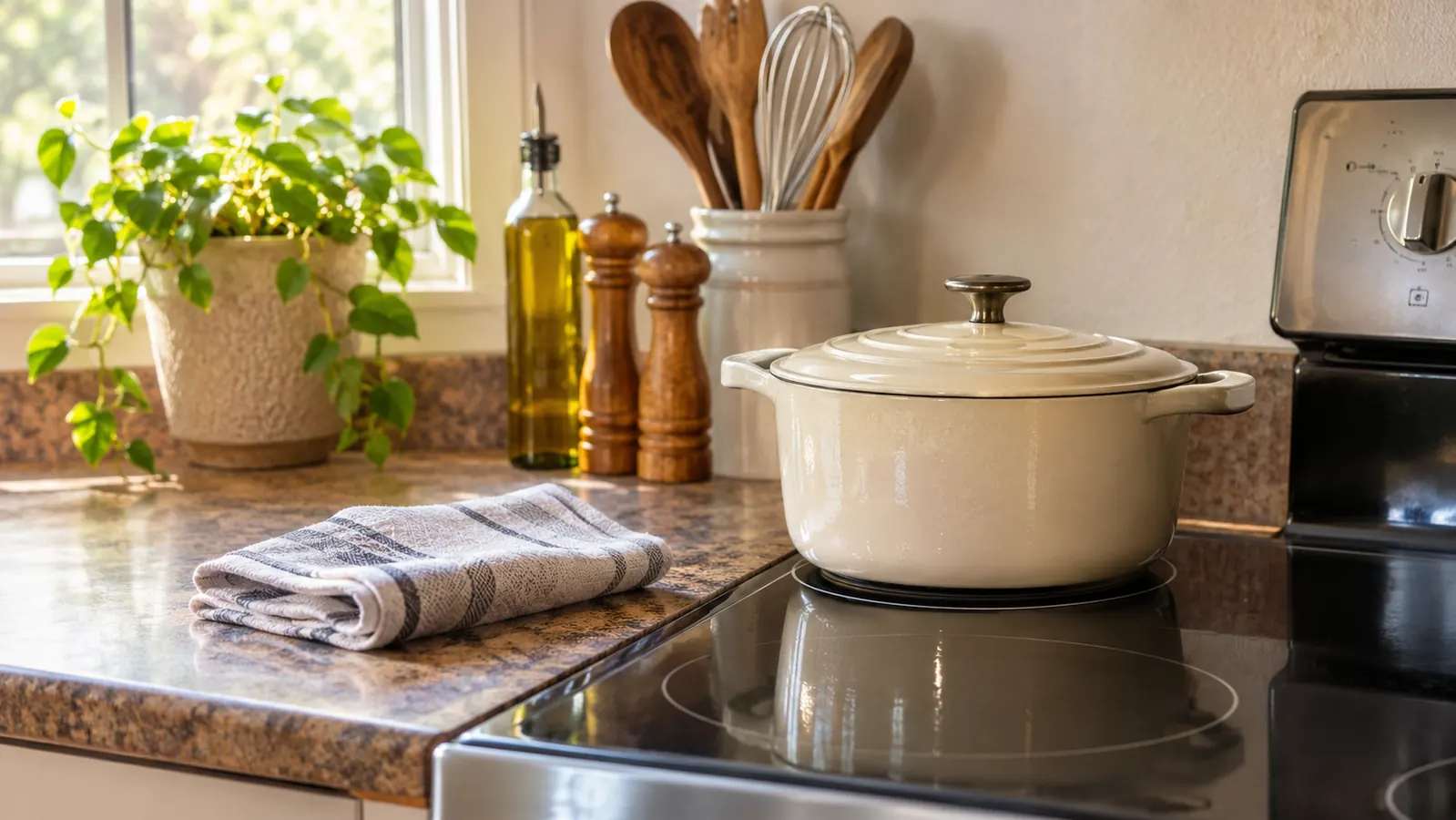
Three things about the Lodge Essential Enamel 6 quart Dutch oven that no product photo will tell you. It weighs 13.5 pounds empty. The enamel chips if you are careless with it, and mine has a chip on the outer rim to prove it. And it is hand wash only, which matters more than the listing makes it sound. I have cooked in mine since the first week of March, two or three times a week plus every Sunday dinner, so I have had time to stop being impressed by it and start being honest about it. This is the review I wish I had read in February.
Most Dutch oven reviews are written in the first two weeks, while the pot is still new and the writer is still in the honeymoon phase. That is not useless information, but it is incomplete. The useful information shows up later: which parts get dirty in a way you did not expect, which parts you stop noticing, which parts you start resenting at 6:30 on a Tuesday. I am 63, I taught high school chemistry for 31 years, and I cook dinner in a small kitchen in Asheville with about eight feet of laminate counter and an electric glass-top range. Nobody sent me this pot. I bought it with my own money after my thin stainless stockpot scorched one braise too many, and that stockpot now exists strictly for pasta water.
The Quick Verdict
Heavy, honest, and it will outlast whatever nonstick pot you are replacing. The chip risk and the hand washing are real costs, not fine print, and one of them caught me in month one.
Amazon Check Today's Price →The pot I would buy again, if my back agreed
6 quarts of enameled cast iron, oven safe to 500 degrees Fahrenheit, and on my stove every Sunday. Check today's price before you decide.
Amazon Check Today's Price on Amazon →The Weight Is Not a Detail, It Is the Whole Design
Thirteen and a half pounds is the number in the specifications and it is accurate. What the number does not convey is what 13.5 pounds feels like once it is full. Six quarts of chili, plus the iron, plus a lid that is heavy in its own right, and you are moving something close to 25 pounds from the stove to the counter with two hands in oven mitts. My wife Ruth is 61 and works part time at the library, and she will not lift it full. I do not ask her to. We have a rule now: the pot stays on the stove until it has cooled enough to move with bare hands, or I move it and she clears a landing spot.
That is not a complaint, exactly. The weight is the point. Cast iron is dense, density means thermal mass, and thermal mass is the reason the thing works at all. A heavy pot takes a long time to heat up and a long time to cool down, so when you get it to a bare simmer it stays at a bare simmer instead of surging and stalling every time the element cycles on and off. My electric range cycles whether I like it or not. The Lodge smooths that out in a way my old thin stockpot never managed in twenty years.
The tradeoff is that the same mass steadying the heat also makes the pot awkward to handle when it is hot and full. I lift it on and off the burner rather than sliding it, partly because of the glass top and partly because you should not drag cast iron across anything. If you have wrist trouble, shoulder trouble or a bad lower back, handle one of these in a store before you order it online. That is the most useful sentence in this review and it is the one most reviews skip.
The Chip I Put in It in the First Month
Enamel is glass fused onto iron. That is not a metaphor, it is literally a glass layer, and glass does not dent. It chips. In the first month I bumped the rim of the pot against the kitchen faucet while filling it, not hard, and a small chip came off the outer rim. The cooking surface itself is untouched eight months later. The pot has not rusted there or behaved differently in any way I can detect. But the chip is there, it is mine, and I put it there.
The lesson I took from that is simple. Handle the rim the way you would handle a drinking glass, because that is roughly what it is. No metal utensils in the pot, not because a metal spoon will strip the enamel in one stroke, but because it will do it a thousand tiny times. No dropping it into a sink full of other dishes. And no pouring cold water into a hot pot to speed up the cleaning, which is thermal shock and is exactly how people crack enamel. Let it come down to room temperature, then wash it.
The other thing nobody tells you is that the rim is where enamel pots die. The interior gets all the attention because that is where the food is, but the rim and the outside are what take the knocks: the faucet, the oven rack, the edge of the sink, the corner of a cabinet. If you are careful with those, the pot will outlast your interest in it. If you are not, you will have a chip in month one like I do.
What Eight Months of Real Cooking Looks Like
Since March I have used this pot for braises, soups, chili and bread, two or three times a week, plus every Sunday dinner when the family comes over. The pattern that emerged is that the Lodge is at its best in the long, low, wet cooks and simply fine at everything else. Nothing about it is fast. Everything about it is steady.
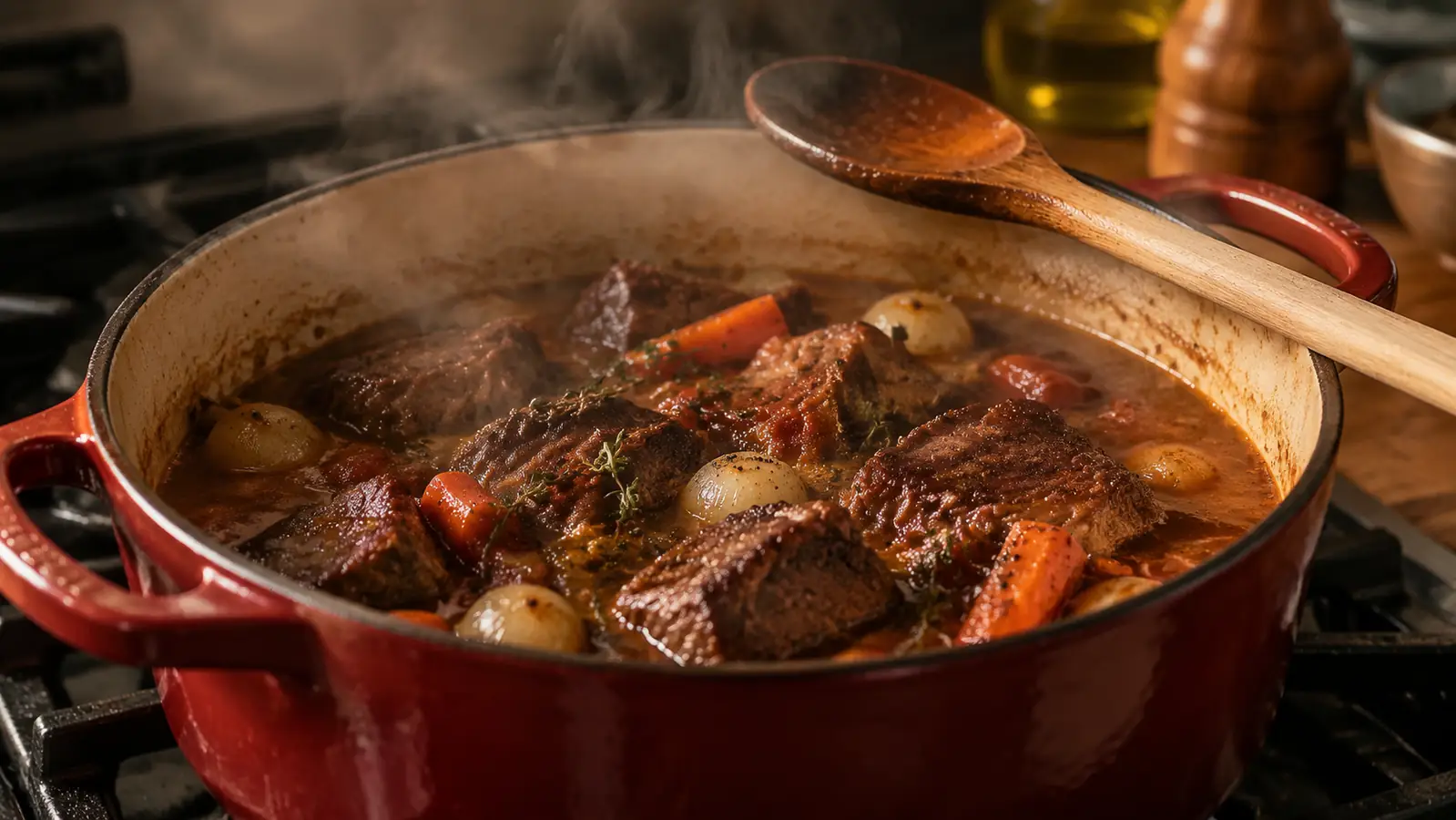
Braised short ribs are the test I keep coming back to. Brown the meat in batches, take it out, cook the onions down in the fond, deglaze, put the meat back, add liquid, lid on, oven at 325. Three hours later the meat gives way under a fork and the bottom of the pot is clean. In my old stockpot the same recipe produced a scorched ring on the bottom every single time, plus a faint burnt note in the sauce that I pretended not to taste. Ruth tasted it. Ruth always tastes it.
Bread is the other thing it does well, and the thing I did not expect to care about. A round six quart pot with a heavy lid holds heat like nothing else in my kitchen, which is what a loaf wants, and the enamel means I do not have to think about seasoning it or about the acidity of a sourdough starter. It is not a dedicated bread oven and I would not buy it for bread alone. But if you already own it, the bread is a free bonus you should try at least once.
The Fine Print: Hand Wash, Heat and My Glass-Top Range
The listing says hand wash only and oven safe to 500 degrees Fahrenheit, and I would take both of those seriously. Hand wash is not marketing nervousness. The enamel is hard but it is not indestructible, and a dishwasher runs hot, uses harsh detergent and knocks everything against everything else for an hour. I wash mine by hand with a soft sponge and hot water and it takes about ninety seconds. That is the whole cost of owning it.
The temperature rating is the one people get wrong. 500 degrees is a real ceiling, not a suggestion, and it applies to the pot and lid together. I use mine at 325 for braises and 450 for bread, both comfortably under. If a recipe wants you to blast something at 550, reach for a sheet pan or a skillet instead. The pot will not thank you for testing the limit.
Then there is my stove. I have an electric glass-top range, not gas and not induction, and Lodge does not state in the listing that this pot is approved for glass tops. I want to be clear about that, because it is the sort of thing readers get burned by and then blame a review for. What I do, and what I can tell you has worked in my kitchen since March, is use medium heat, lift the pot on and off rather than sliding it, and never set it down hard. No marks on the cooktop so far. That is my experience, not a manufacturer promise, and you should treat it as exactly that.
If you have gas, you have the easiest version of this problem. If you have induction, the cast iron body should be happy on it, though I have not tested that myself. If you have glass, be gentle and read your own range manual, which will tell you more than any article can.
Where It Genuinely Beat My Old Stockpot
The honest case for this pot is one sentence long: it holds a steady temperature, and steady temperature is what separates a braise from a stew that tastes burnt. My stockpot was thin metal. Thin metal responds instantly to the burner and instantly to the absence of the burner, which on an electric range means it surges and stalls in a cycle you can watch with your own eyes. The Lodge does not do that. It takes ten minutes to come up to temperature and then it just sits there, holding.
There is a second thing, which is the lid. The lid on this pot is heavy and fits closely, so it traps steam instead of venting it, and a pot that traps steam does not dry out over three hours. I used to have to add liquid to the stockpot halfway through a braise or risk the bottom catching. I do not with this one, and the sauce at the end is deeper because of it.
And the third thing is that the enamel lets me cook tomatoes and wine without worrying. Bare cast iron and acid do not get along. Enamel does not care. That sounds like a small point until you notice that half the braises worth making start with a deglaze of wine or vinegar, and I had quietly stopped cooking those recipes. When I got this pot I stopped avoiding them.
Where It Still Annoys Me
It is 13.25 inches wide and 6 inches high, and it lives on my back left burner when it is not in use, because there is nowhere else for it. It does not stack, it does not nest, and it does not share a cabinet shelf with the lids. In a kitchen with eight feet of counter that is a genuine cost. If your cabinets are already full, think about that before you order.
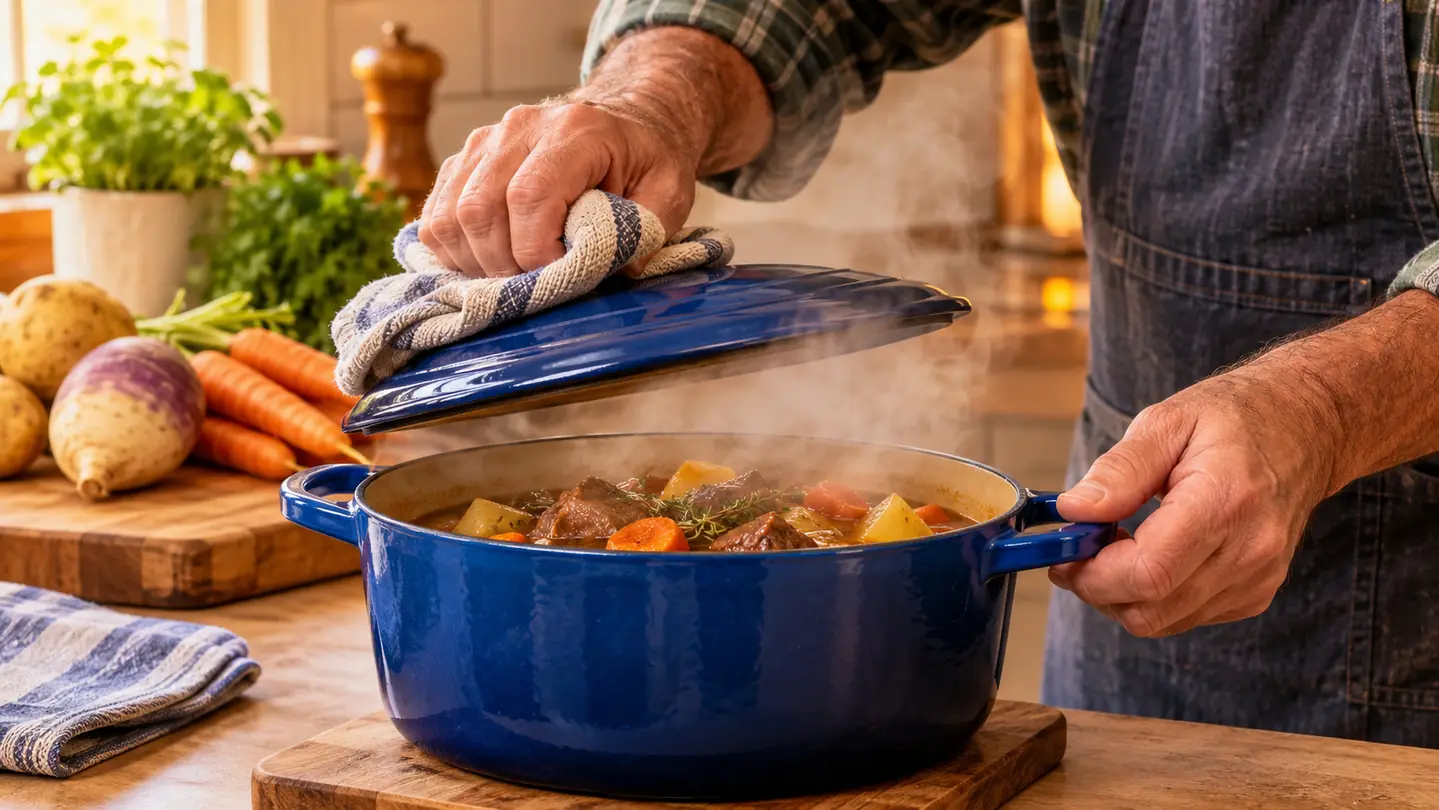
The lid handle gets hot enough in the oven that you cannot grab it bare handed. That sounds obvious until you are three hours into a braise and reaching for it on instinct. I keep a folded towel on the counter next to the stove now. The other small annoyance is the rim, which needs drying rather than sitting wet in a dish rack overnight. Two tiny habits, but they are habits you will have to build.
What I Liked
- Holds a steady temperature on an electric range that cycles, which is the whole reason to own cast iron
- The heavy lid traps steam, so a three hour braise no longer needs topping up
- Enameled finish handles wine and tomatoes, so deglazing stopped being a problem for me
- Oven safe to 500 degrees Fahrenheit, and 6 quarts is enough for a family Sunday dinner
- Eight months at two or three uses a week and the cooking surface is still unmarked
Where It Falls Short
- 13.5 pounds empty and close to 25 full, and Ruth will not lift it
- The enamel chips on impact, and the rim is the first thing to go
- Hand wash only, and the rim needs drying afterward
- 13.25 inches wide, so it takes a whole burner or a whole cabinet shelf
- Lodge does not state that it is approved for glass-top ranges, so you are on your own there
The braise that scorched in my thin stockpot every single time came out of the Lodge with a clean bottom and a sauce I did not have to apologize for. One pot of short ribs is all the proof that took.
Who This Is For
This is for the cook who makes braises, soups, chili and the occasional loaf, has a stove that cycles, and is willing to move a heavy pot with two hands. It is for someone who wants one pot that will still be in the kitchen in twenty years and does not mind ninety seconds of hand washing afterward. If you cook for a family every Sunday, six quarts is the right size and I would not drop to a smaller one.
It is also for the cook who has been quietly disappointed by thin cookware and has not worked out why yet. If your stews taste faintly burnt at the bottom and you have been blaming the recipe, the pot may be the real culprit. That was my situation for years and I did not see it until the stockpot finally scorched a braise badly enough that I could not pretend otherwise.
Who Should Skip It
Skip it if you have wrist, shoulder or back problems. I mean that. Thirteen and a half pounds empty is fine for me at 63 and it will not be fine forever, and no version of this pot gets lighter with age. A lighter enameled pot or a good heavy stainless one will braise nearly as well and you will actually take it out of the cabinet.
Skip it if you want to put it in the dishwasher, if you want to store it in a stack of pans, or if you want cookware you can bang around without thinking. Enamel rewards a little care and punishes carelessness, and if that trade does not appeal to you, buy something else and be happier. And skip it if you mostly boil pasta. That is what my old stockpot still does, and it does it perfectly well.
Eight months in, the chip on the rim is the only thing I regret
6 quarts, enameled cast iron, oven safe to 500 degrees Fahrenheit, and it has earned permanent counter space in my kitchen. Check today's price and see whether it fits yours.
Amazon Check Today's Price on Amazon →