
I bought the Anova Precision Cooker Nano 2.0 from Anova Culinary in the first week of March, in the same week I replaced a knife block, a stockpot and a hand mixer that had all given up on me at once. I have used it once or twice a week since, call it forty cooks. That is not a lifetime, but it is long enough to know where it bites. In that time it has turned out the best pork chop I have made in thirty five years of cooking dinner, and one chicken breast so dry that Ruth set her fork down and asked, kindly, what had happened.
Here is the short version, and then I will take it apart. This is a small, honest machine from Anova Culinary that holds a water bath steady and does steak, chicken, pork and eggs very well. It is also a machine with a listed top temperature of 197 degrees and an 800 watt heater, and those two figures decide most of what it can and cannot do for you. So this is not the review that tells you sous vide will change your life. It is the review that tells you what this one does, and what it will not.
The Quick Verdict
A genuinely small cooker that nails steak, chicken, pork and eggs, with a 197 degree ceiling and 800 watts of heat that rule out the boiling jobs you may have assumed it could do.
Amazon Check Today's Price →The sous vide that earns its drawer space
It holds a bath steady for hours, sets from the unit itself or the free app, and stores in a drawer. The two things it will not do are further down this page.
Amazon Check Today's Price on Amazon →How I Actually Use It
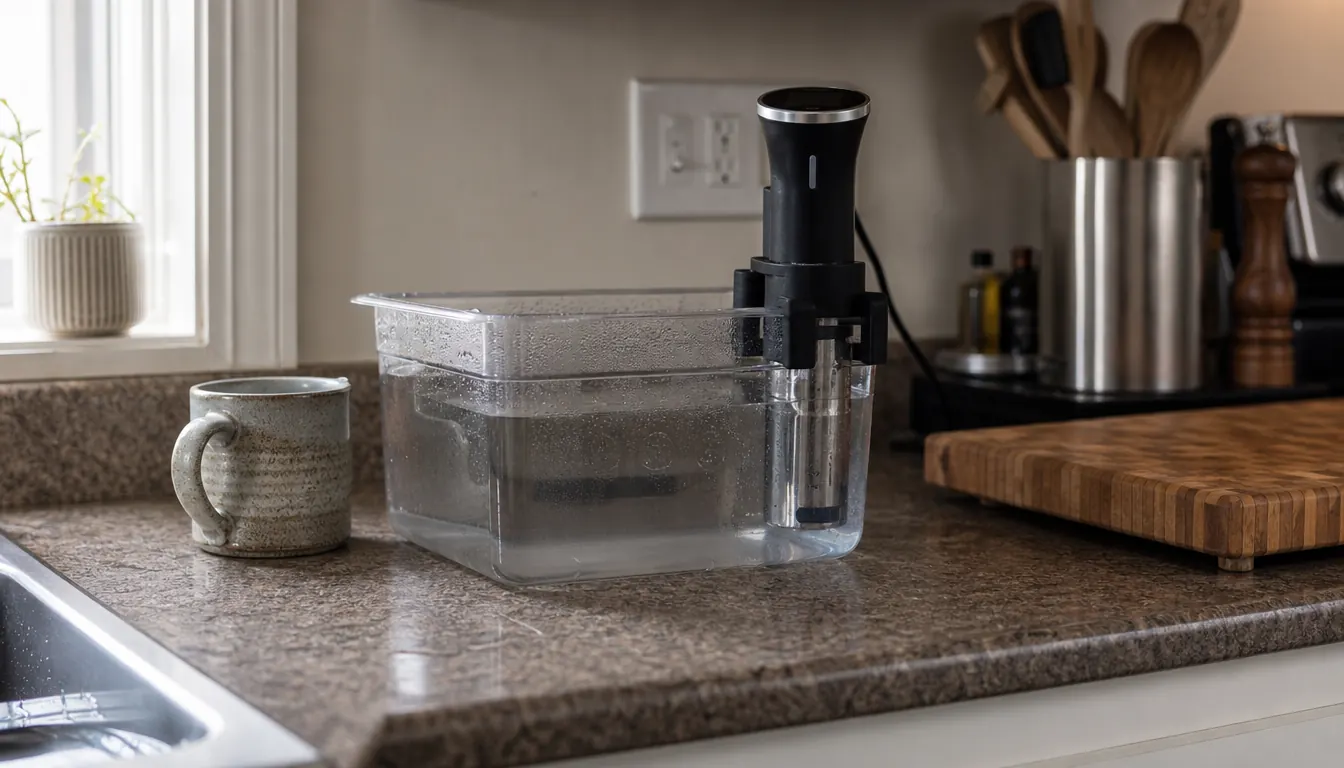
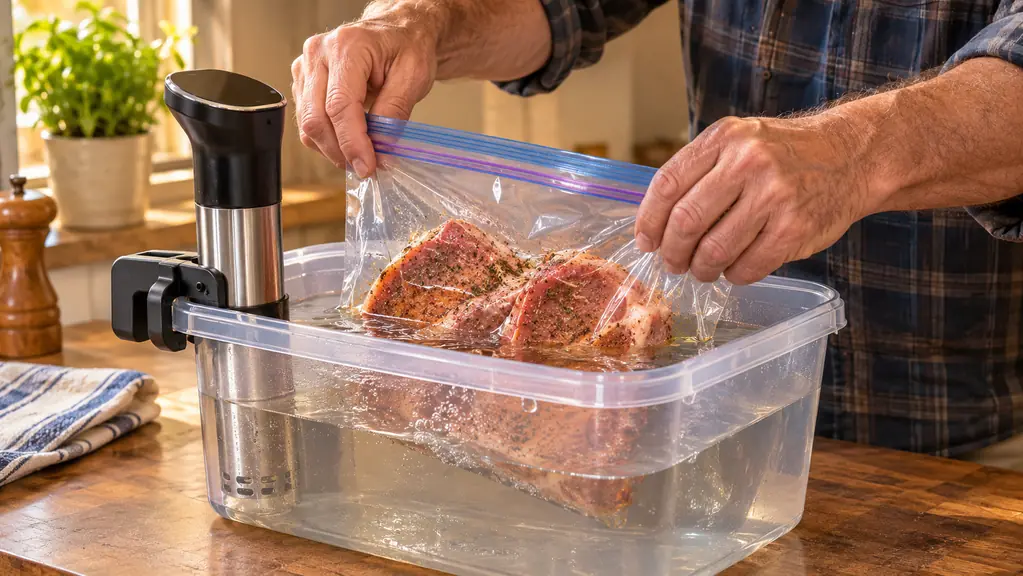
The cooker lives in the drawer under the oven when it is not working, which is the whole reason I bought this size. It is 12.8 inches tall and 1.7 pounds, so it goes in beside the whisk and the ladle without a fight. When it comes out, I clip it to the side of a 12 quart plastic food container, fill that from the tap, and set the temperature on the controls on the unit itself. I do not own a vacuum sealer. I use zip-top freezer bags and the water displacement method: lower the bag into the water with the seal open, let the water press the air out, then close it. That is the whole rig.
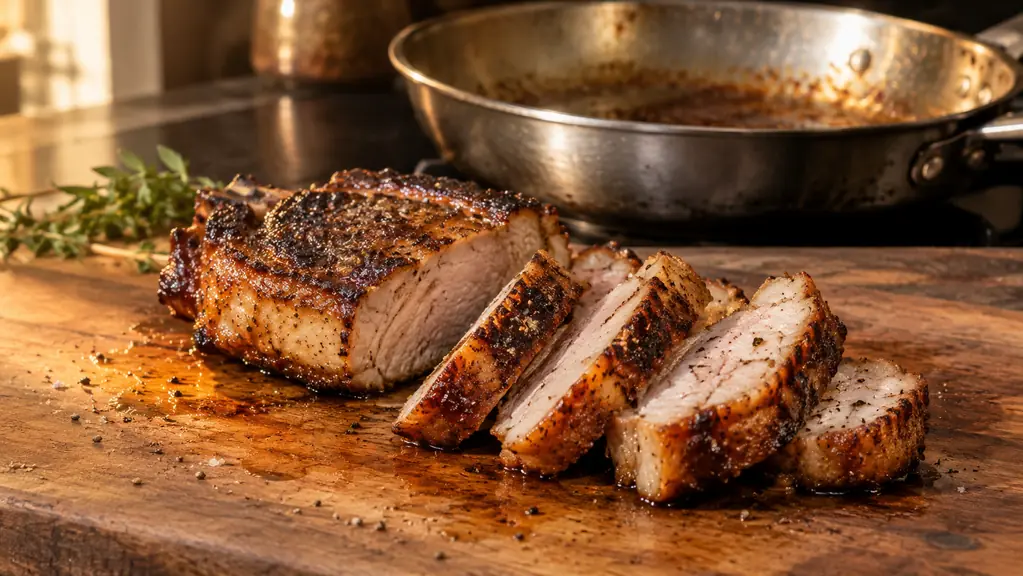
After the cook I take the bag out, dry the meat, and sear it in an old 12 inch stainless skillet on the electric glass-top range. The sear is where the flavour comes from, and the cooker has nothing to do with it. Anyone who tells you the machine makes the steak is selling you something. The machine makes the temperature, and the temperature was the part I kept getting wrong.
What surprised me, as a man who taught chemistry for thirty one years, is how much of cooking turns out to be a problem of holding a variable steady. A bath at 140 degrees is a controlled condition. A pan on a glass-top range is a variable I am adjusting by feel. Having one dish at dinner that I cannot ruin by looking away has been worth more than I expected it to be.
The first cook was a disaster in a boring way. I used a bag I had not sealed properly, water got in, and I served Ruth a pork chop that had been poached in its own diluted marinade. She ate it. She said it was fine. It was not fine. The second cook, done properly, was the pork chop I mentioned at the top, and the distance between those two dinners was about ninety seconds of paying attention.
I check the bath once or twice with a TempPro instant-read probe I keep in the drawer by the stove. It has read within a degree of what I set every time I have bothered to look, which is either a good sign or a sign that both instruments are wrong in the same direction. I prefer the first explanation.
The 197 Degree Ceiling, and Why It Matters More Than the Marketing Suggests
The listed range runs from 32 degrees to 197 degrees Fahrenheit. The bottom number is not interesting. The top number is the one to think about. Water boils at 212 degrees at sea level and around 208 here in the mountains, and this cooker stops a good deal below either. So it is not a poaching pot, not a stock pot, not a way to simmer, and not a way to cook anything that wants a rolling boil.
For meat and eggs, 197 is plenty. Steak at 130, chicken breast at 145, pork at 140, eggs anywhere from 145 for a soft yolk to 165 for one that peels cleanly. All of that sits comfortably under the ceiling. Where I ran into it was vegetables. Carrots that want 183 are fine. Potatoes and corn and anything I would normally think of as a boil are at the very top of the range or past it, and what came out was not good enough to repeat. I did those in a pot on the range instead, which is what I would have done anyway.
So the ceiling is not a defect exactly. It is a boundary, and the listing is honest about where the boundary sits. A bigger and more powerful machine would go higher. This one does not, and if vegetables are most of what you cook, that is worth knowing before you buy rather than after.
A one and a half inch pork chop at 140 degrees for two hours, then ninety seconds a side in the stainless skillet, is the best pork I have made in thirty five years of cooking dinner. The cooker did the part I used to get wrong.
800 Watts Is a Real Number
The heater is 800 watts on 120 volts. I did the arithmetic when it arrived, because that is the sort of thing I do. Twelve quarts of water is about eleven litres, and lifting that from cold tap temperature to 135 degrees takes real energy. At 800 watts, starting from cold, it is the better part of forty minutes. I know because I stood there the first time and watched it climb.
I do not do that any more. I fill the container from the hot tap, which starts it near 120, and the machine reaches temperature in about fifteen minutes. Once it is there, it holds. That is the part that matters and the part 800 watts is genuinely good at. A bath already at temperature, with a sheet of foil over the container to keep the heat in, sits steady for hours.
Where the wattage shows is recovery. Put four pork chops straight from the refrigerator into the bath and the temperature drops, then climbs back. On a cool morning with the kitchen window open, that climb is slower than I would like. It has never failed to get there. It has made me plan the timing rather than assume it.
What the App Does
The Anova Culinary app is free, and the listing says you can control the cook on the app or on the cooker itself. Both of those are true and I have done both. The recipes are the part I use. If I want to know what temperature a duck breast wants, or how long a chuck roast should go, the app has an answer close enough to start from, and I adjust from there based on what happened last time.
The timers are the other half of it. I set a cook, walk away, and do something else, and the timer tells me when to come back. For a man who has burned things because he went out to the garage, that is not a small feature. It is the feature.
The controls on the unit itself are perfectly usable too. Most nights I set the temperature right there on the cooker and never open the app at all. The app is a convenience, not a requirement, and I want to be clear about that, because the word precision in the product name makes people assume the phone is doing the work.
Two cooks it has helped with: a two inch chuck roast at 135 for thirty hours that came out like sliced roast beef, and chicken thighs at 165 for four hours that Ruth has asked for twice since. I would not have known either number without it. I would have guessed, and my guesses were worse.
What the App Doesn't Do
It does not tell you that a bag has floated. A zip-top bag with a pocket of air left in it will rise, and half the meat will sit above the waterline, and you find out when you open it. I weigh mine down with a metal spoon now. There is nothing in the app that would have caught that for me.
It does not sear, and it does not know how you like your steak. The app will tell you 130 degrees because 130 is medium rare by the book. If 130 is not medium rare to you, the app does not know that and will not learn it. Ruth likes hers closer to 140 and I have written that on a card that lives in the drawer. The card is doing more work than the software.
It does not teach you to season. The largest single improvement in my cooking this year was not the machine. It was salting the meat an hour before it goes into the bag instead of at the skillet. The app did not tell me that. I read it somewhere, tried it, and it worked, and now I do it every time.
The Annoyances, in the Order They Bite
Water disappears over a long cook. Four hours at 140 in an open container and the level drops enough that I top it up. I keep a jug beside the machine now, and for anything over two hours I put a sheet of foil over the top.
The container takes counter space, and this kitchen has about eight feet of laminate counter to its name. Twelve quarts is not small. When the machine is out, something else has to move, usually the cutting board, and Ruth has opinions about that. The drawer size of the cooker is a little misleading, because the container is the thing that actually needs a home.
Zip-top bags fail. I have had two seals give way in eight months, both on bags I closed in a hurry. Neither ruined a dinner, but both put water in with the meat and both cost me a pork chop. A vacuum sealer would not do that. I have not bought one, because two failures in forty cooks does not yet justify the cost or the cupboard space.
The pump is quiet enough that I forget it is running, which is the good news. Cleaning is easy: the part that sits in the water gets wiped and dried, the plastic body gets wiped, and it goes back in the drawer. Anova Culinary did not overcomplicate the outside of this thing, and the whole routine takes two minutes.
What I Liked
- Holds a water bath steady enough that steak, chicken, pork and eggs come out the same way every time
- 12.8 inches tall and 1.7 pounds, so it stores in a kitchen drawer instead of a cupboard shelf
- Controls on the cooker itself, so the phone is optional on a weeknight
- The free app carries recipes and timers that a beginner can actually use
- Works with zip-top freezer bags and water displacement, so no vacuum sealer is needed to start
- Two year warranty
- The 32 to 197 degree range covers every protein and egg cook I have wanted to do
Where It Falls Short
- 197 degrees at the top rules out boiling, simmering and the higher temperature vegetable cooks
- 800 watts means the better part of forty minutes to heat twelve quarts from cold
- The app is a recipe book and a timer, not a teacher, and it cannot correct a floating bag or a bad seal
- The cooker is small, but the 12 quart container it needs is not, and that is what takes the counter
- The container, the bags and a way to weigh them down are all on you. Only the cooker is in the box
Who This Is For
If you cook dinner most nights and you want one dish at the table that you cannot ruin by looking away, this is a good use of a drawer. If you are new to sous vide and want to find out whether the method suits you before spending serious money, this is the sensible place to start. It also suits a small kitchen, with the caveat about the container. The machine takes up almost nothing. The bath takes up a good deal.
It suits a cook who is willing to sear afterwards. The machine stops at the bath. Everything that makes meat taste like meat happens in a hot pan in the two minutes after. If you are not going to do that, sous vide will give you evenly cooked, pale, faintly sad protein, and you will conclude the method is overrated and tell people so.
Who Should Skip It
Skip it if you want to cook vegetables in it, or if you were hoping for one appliance that replaces a pot. The 197 degree ceiling is real and it is not going to move. Skip it if you regularly feed a crowd and want to hold four or five gallons of water at temperature, because 800 watts and this size of container are not that machine.
And skip it if you are looking for something that does the thinking for you. It holds a temperature beautifully. The thinking is still yours. That is the honest version of what eight months has taught me.
What I Would Tell You Before You Buy
Fill the container from the hot tap. Salt the meat an hour ahead. Weigh the bag down. Sear in a pan hotter than you think it should be. Check the water line on anything over two hours. If you do those five things, this cooker will make you look like a better cook than you are, and it will do it on a Tuesday. That is the whole of what I know after forty cooks, and it is worth more than any of the specifications above.
Small machine, steady bath, dinner on a Tuesday
It will not boil water for you and it will not sear the chop. It will hold 140 degrees for as long as you ask it to, which is the part I could never manage by hand.
Amazon Check Today's Price on Amazon →