
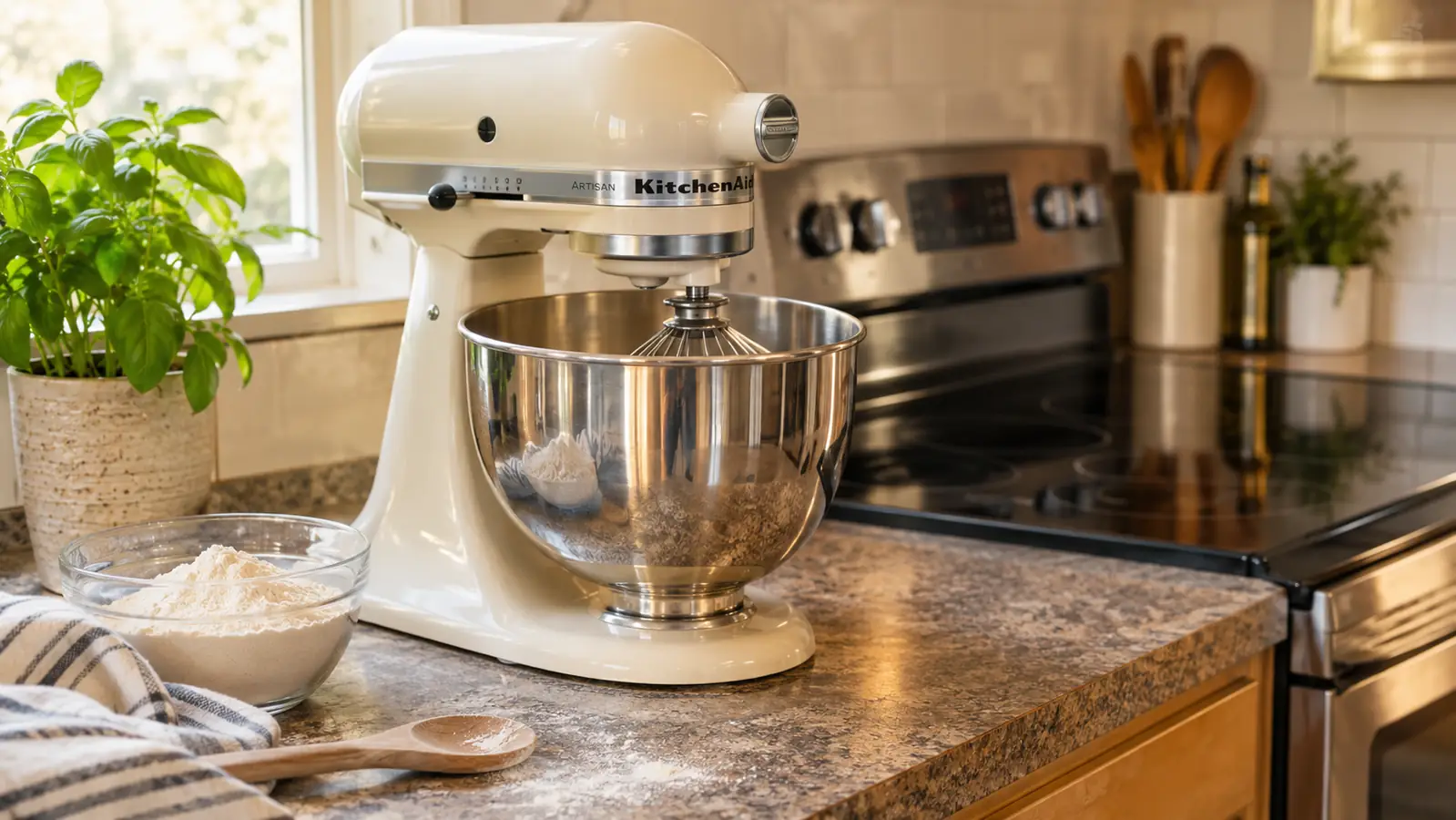
My son owns a Hamilton Beach stand mixer and believes it is the sensible purchase. I own the KitchenAid Artisan, bought in the first week of March with my own money, and it has sat on the counter by the window ever since. We have gone back and forth about this across his kitchen table, politely, the way a father and a grown son do when neither of us wants to hand over the last word. He is not wrong about his. That is the part that makes this worth writing down.
Here is the short answer before the long one. The KitchenAid is the better machine, and it is not close on build, on the bowl or on the speed control. The Hamilton Beach is the better buy for a great many kitchens, possibly including my son's, because most homes do not need twenty-two pounds of gearbox to make a birthday cake twice a year. The question that settles it is not which mixer is better. It is whether you knead bread, or whether you cream butter. Everything below is the reasoning, including the two places where the cheaper mixer wins and the afternoon I spent at my son's counter proving it.
| KitchenAid Artisan | Hamilton Beach | |
|---|---|---|
| Cost | The premium option. You pay for the motor, the metal and the bowl. | The lower-cost option by a wide margin. |
| Motor and frame | 325 watts in a 22 pound metal frame that stays put under a stiff dough | Lighter housing with more plastic in the case, and it shifts on the counter under a heavy dough |
| Bowl | 5 quart stainless steel, handle on the side, twists to lock and lifts out | Smaller bowl with no handle on the model I have used, so it takes two hands |
| Speed control | 10 speeds on a single knob, slow enough to fold flour in without throwing it up the sides | Fewer speeds, six on the one at my son's house |
| Cleaning | Bowl, flat beater, dough hook and wire whip all lift out. Mine get washed by hand. | Bowl and beaters lift out the same way, with fewer pieces to wash |
| Weight and storage | 22 pounds, which is why it lives on my counter and always will | Light enough to lift out of a cabinet one-handed |
| Batch size | The listing claims 9 dozen cookies in a single batch from the 5 quart bowl | Smaller batches, fine for a cake or a tray of muffins |
| Warranty | One year limited, per the listing | Check the listing for the exact model you buy, it varies |
| Best for | Weekly bread and big batches in a kitchen with counter room to spare | Occasional baking in a small kitchen |
Where the KitchenAid Artisan Wins
A stand mixer is a gearbox with a bowl bolted underneath it. Everything you feel at the counter comes down to how much of the motor's effort reaches the dough and how much is lost to wobble, noise and a machine trying to walk toward the edge of the counter. The Artisan runs at 325 watts and weighs 22 pounds, and that weight is the reason a stiff bread dough stays where you put it. My first two loaf batch, back in March, sat there and churned while I got a bowl out for something else. The hand mixer it replaced would have needed a hand on it the whole time, and my wrists would have felt it by Thursday.
The bowl is the part I did not expect to care about. Five quarts of stainless steel with a handle on the side that twists to lock into the base, which means I can lift a full batch of dough with one hand and set it down on the butcher block without bracing the mixer with the other. Ten speeds on one knob, and the low end is genuinely slow, slow enough to fold flour into a batter without throwing it up the sides of the bowl. At the top end, a cup and a half of cream takes about two minutes, which is roughly the time it takes Ruth to set the table.
There is a line in the listing about 59 touchpoints around the bowl, which is marketing language for a finish that does not flake the first time you set the bowl down hard. I have set mine down hard. Eight months in, the coating on the flat beater and the dough hook is intact, the bowl has no dents, and the head still tilts up and locks with the same firmness it had in March. That is not a thrilling sentence to write. It is the sentence that matters when you are deciding whether to spend the extra money.
Where the Hamilton Beach Wins
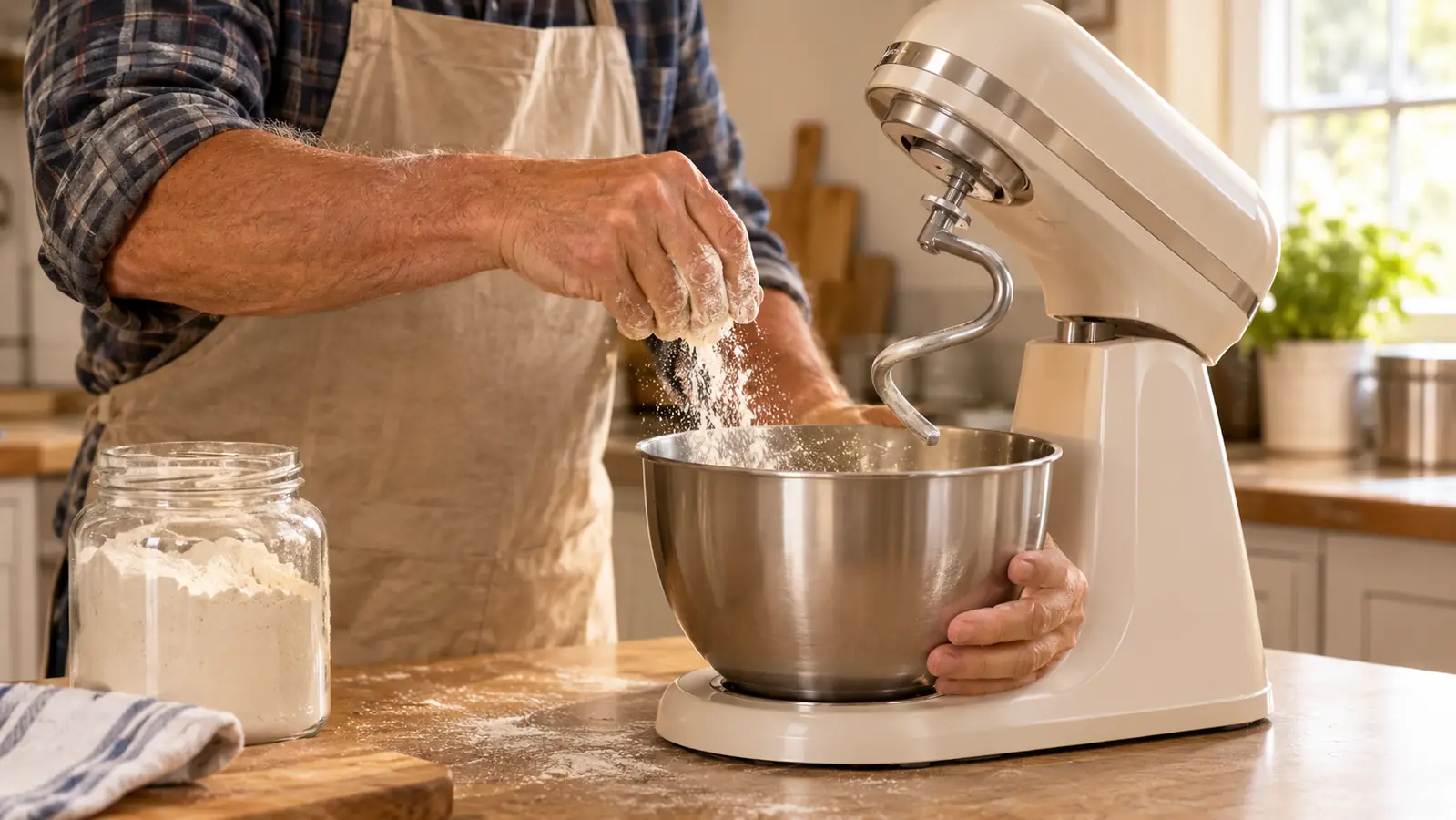
The Hamilton Beach costs less, and it does what it promises. I made one batch of chocolate chip dough in my son's kitchen with his, standing at his counter, and it came together without drama. The head tilts, the beaters turn, the bowl locks, and the cookies were good. It is also light enough that he keeps it in a cabinet and lifts it out with one hand, which the Artisan at 22 pounds does not invite you to do. In a kitchen with a few feet of counter and no spare corner, that is not a small thing. It is most of the argument.
There is also a version of this where the Hamilton Beach simply wins. If you bake a cake for a birthday, a batch of cookies at Christmas and muffins on a Sunday, the extra capability of the KitchenAid sits unused, and unused capability is the most expensive kind of clutter in a kitchen. My son has never once wished his mixer were heavier or made of more metal. He wishes mine fit in his cabinet, and it does not, and that is the whole of his complaint. A tool that gets used beats a better tool that stays in the cupboard. That is not a consolation prize. That is the point of owning anything.
The mixer that kneads bread without walking across the counter
A 5 quart stainless bowl, ten speeds and a 22 pound frame heavy enough to sit still under a stiff dough. 4.7 stars across more than 30,000 ratings, with a one year limited warranty behind it.
Amazon Check Today's Price on Amazon →What Eight Months of Owning the Artisan Actually Taught Me
I bought it because kneading by hand had started to bother my wrists, and the hand mixer in the cabinet could not handle a slack dough without stalling. Since March it has made Sunday bread most weeks, pizza dough when the grandkids come, cookies in batches I will not admit to Ruth, and whipped cream for a pie. Call it once or twice a week. That is not heavy use by the standards of anyone who bakes for a living, but it is heavy enough to find out what a machine does once the novelty wears off. I keep a note on the inside of a cabinet door with the dates and what I made, the way I used to keep lab notes, and the pattern is dull and consistent. It did the job. Nothing went wrong.
What I did not expect was how much of the work happens in the bowl rather than in the motor. The dough hook kneads on a schedule I can set and walk away from, which means the bread gets the full ten minutes instead of the six I used to give it before my arms got tired. The flat beater creams butter and sugar in a way a hand mixer never did, because the whole bowl gets swept instead of one narrow path through it. The tilt head turns out to be a larger thing than it looks. You lift the top, the bowl comes free, and you are not fighting the machine to scrape down the sides.
The complaints are real, so here they are. It weighs 22 pounds, which means mine lives on the counter and always will, and if your counter space is tight you should count that cost before you count anything else. Flour collects in the hinge of the tilt head and needs a brush now and then. The bowl and the beaters get washed by hand in this house, which is my habit more than any rule. And it is not a bread machine. It kneads the dough. You still shape it, proof it and bake it, and no appliance will do that part for you, no matter what the box suggests.
The dough hook does what my wrists used to do, and it does not complain on the second loaf.
Where the Money Goes
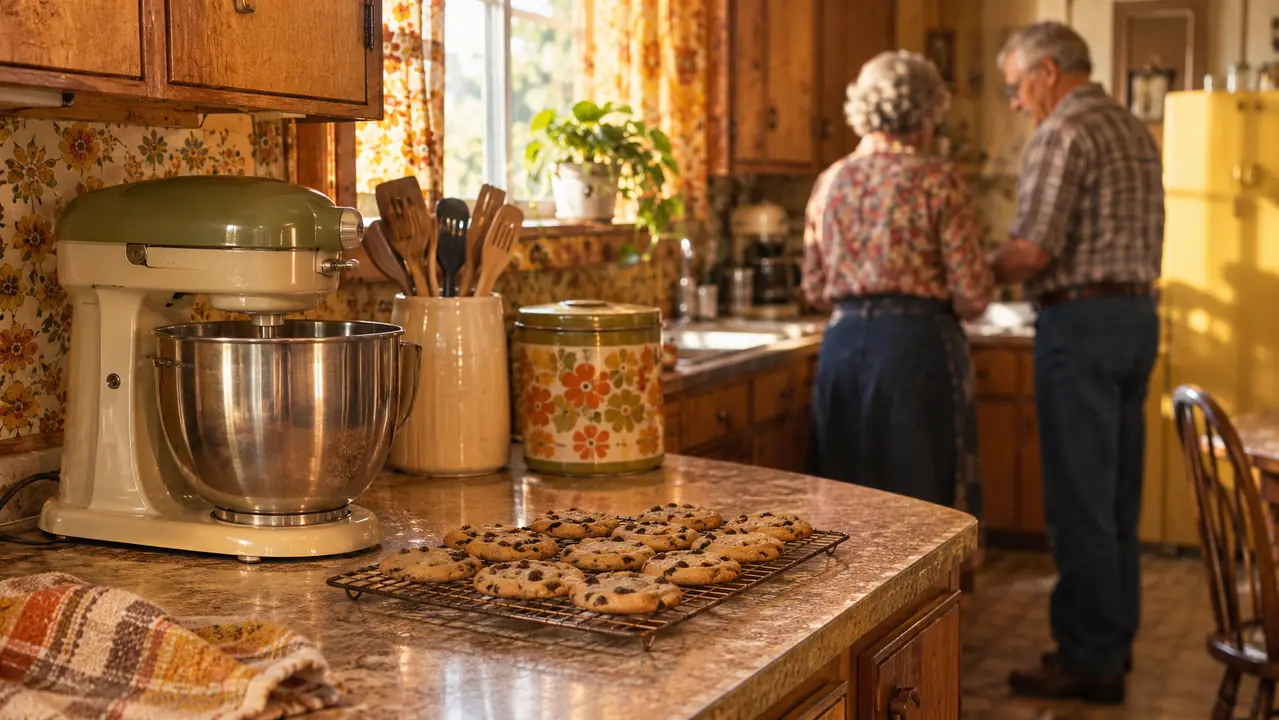
People assume the extra money buys the name on the front. It does not, or not mostly. It buys a metal frame and a gearbox built to take a load, a bowl with a handle that locks, and a set of coated tools that survive being dropped in the sink. The Artisan carries a one year limited warranty, which is honest but not remarkable, and the reason that warranty is rarely the thing people talk about is that these machines tend to outlast it by a wide margin. What you are really buying is the odds that the thing on your counter in fifteen years is the same thing on your counter today.
The counterargument is just as sound. Paying for fifteen years of machine only makes sense if you intend to use it for fifteen years. If your baking is a cake in April and cookies in December, you are buying capability you will never spend, and the Hamilton Beach will make that cake just as well with less of your money and less of your counter. I would rather have a modest tool I use than a fine one I admire. That is not a compromise, it is good sense, and I have made that same call on other equipment in this kitchen more than once.
The Small Things That Decide It
Measure your counter before you decide anything. The Artisan is 14.1 inches deep, 8.7 inches wide and 13.9 inches tall, and on my eight feet of laminate it takes the corner by the window and stays there. Height matters as much as width. If your upper cabinets sit low, check that the head clears when it tilts up, because a mixer you have to pull out and turn sideways every time is a mixer that stops getting used. I have watched that happen to a bread machine and a food processor in this house, and neither of them was a bad machine.
Batch size is the other quiet decider. The listing claims nine dozen cookies in a single batch from the five quart bowl, and I have no reason to doubt it, though my one oven and my two sheet pans top out well before that. For bread, five quarts holds a two loaf batch with room to spare. The Hamilton Beach bowl is smaller, which matters less than you would think for a single cake and far more than you would think for double batches of cookie dough in December.
Who Should Buy Which
Buy the KitchenAid Artisan if you knead bread more than twice a month, if you regularly make double batches, if your wrists have started to complain about a wooden spoon, or if you want one machine that handles dough, batter and cream without being babied. Buy it if you have a corner of counter it can live on, because it will live there. The five quart bowl, the ten speeds and the dough hook are not features you use once and forget. They are the entire reason the machine exists, and eight months in I would buy it again without the deliberation.
Buy the Hamilton Beach if your baking is occasional, your counter is short, or your budget has better places to go this year. Buy it if you want a mixer you can put in a cabinet and forget about until the mood strikes. It makes a cake. It makes cookies. It will not knead two loaves of bread the way the Artisan does, and if that sentence does not bother you, you have your answer already. The right purchase is the one that matches the baking you actually do, not the baking you imagine doing in January.
The one I would buy again, and did buy in March
If bread is a weekly habit rather than a holiday project, this is the machine for it. Five quart stainless bowl, ten speeds, 4.7 stars from more than 30,000 ratings.
Amazon See Today's Price on Amazon →