
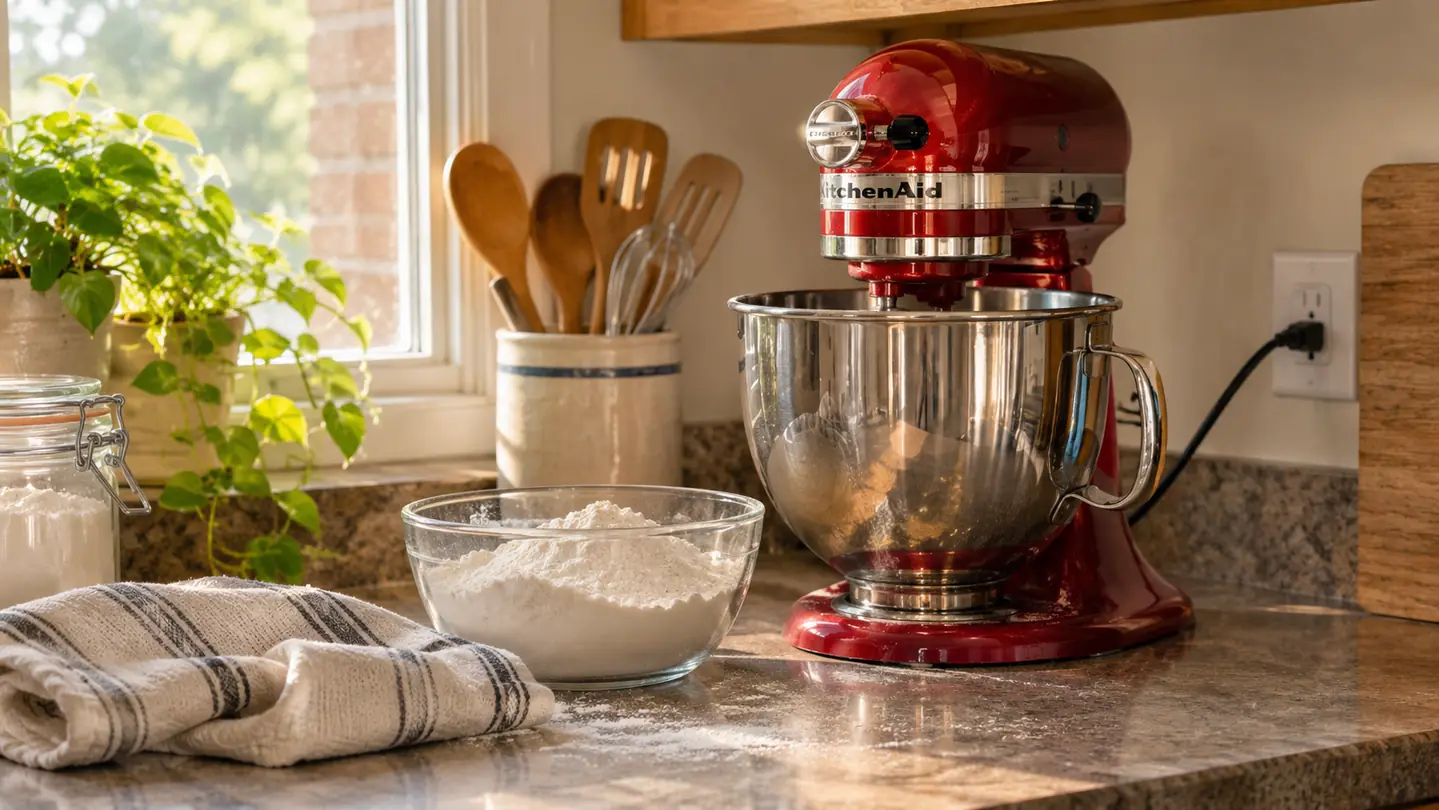
Eight months ago I finally admitted that my kitchen had a worn-out problem and replaced five things at once, all with my own money, in the first week of March. The KitchenAid Artisan stand mixer was the only one of the five that Ruth had an opinion about, and her opinion was entirely about the colour. That machine has not left the counter since.
Here is what it replaced. I kneaded bread by hand on a butcher block, and I whipped cream with a hand mixer that had a habit of walking toward the edge of the counter while I was looking somewhere else. By last winter my wrists were complaining after the second loaf, which is a tiresome thing to admit at sixty-three. I wanted a machine that would take the whole job, not the easy half of it, and I did not want a heavy appliance that folds up under a stiff dough and leaves me finishing the work by hand. So I did what I used to tell my chemistry students to do, which was to write down what actually happened each time I used it. What follows is eight months of those notes.
The Quick Verdict
It handles bread dough, cookie dough and whipped cream without drama, and the five quart bowl is the right size for two people plus a Sunday crowd. It is heavy enough to stay put and heavy enough to be a nuisance, and the one year warranty is shorter than the machine deserves.
Amazon Check Today's Price →A mixer that holds its speed when the dough gets stiff
Ten speeds on a plain knob, a five quart stainless bowl with a handle, and a coated dough hook that kneaded everything I put in front of it. Mine has run once or twice a week since March. Check today's price and what comes in the box.
Amazon Check Today's Price on Amazon →How I've Used It
The mixer lives in the corner of the counter by the window, because that is the only stretch of my eight feet of laminate with enough clearance behind it. The footprint is real: 14.1 inches deep, 8.7 inches wide, 13.9 inches tall, and 22 pounds of it. That weight number matters more than the others. It means the machine does not go into a cabinet between uses, since lifting 22 pounds twice a week is exactly the kind of small chore that makes a person quietly stop using a good tool. It also means it does not creep across the counter the way my hand mixer did.
My routine settled quickly. Sunday mornings are bread or pizza dough, usually two loaves or enough dough for three pizzas. Once or twice a month the grandkids come on a Sunday and I make cookies, three dozen at a time, which takes two batches. Whipped cream happens whenever Ruth decides dessert needs it, which is more often than the calendar suggests. On a normal week the machine runs once or twice. On a Sunday it may run three times. That is not a bakery's workload. It is a home cook's workload, and it is the honest basis for everything below.
I use the four things that came in the box: the five quart stainless bowl, the coated flat beater, the coated dough hook and the six wire whip. I own no extra attachments and have not been tempted by any. The head tilts back on its hinge, you fit or swap the tool, and the bowl twists into its cradle. The bowl lifts off the base, which makes it easy to scrape into a sink or a second bowl. There is nothing to program and nothing to pair with a phone. You turn a knob.
The Five Quart Bowl and What It Actually Holds
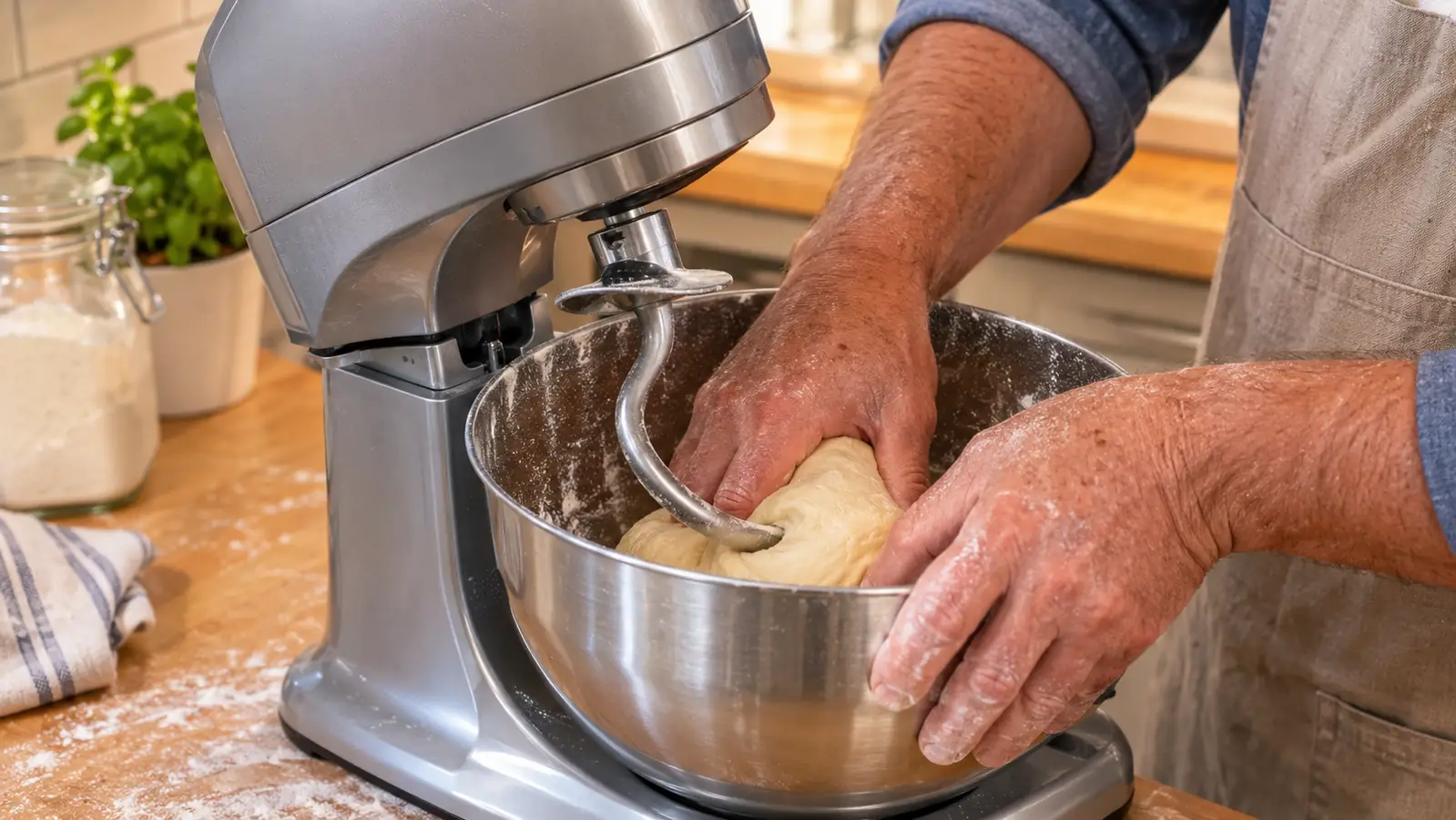
Five quarts sounds like a number until you put something in it. The listing claims nine dozen cookies in a single batch, and while I have not tested that number with nine dozen, I can tell you that three dozen at a time leaves visible room and the beater still reaches the whole mass. Bread dough is the more useful test. About two kilograms of flour, which is my two loaf recipe plus a little margin, fills roughly two thirds of the bowl at the start and climbs as the gluten develops. There is still space for the dough to move, and that is the thing that matters. Dough with nowhere to go just rotates in a lump.
The bowl is stainless with a handle on the side, and the handle is not a decorative detail. Lifting a full dough out of a bowl this size is awkward, and the handle gives you somewhere to hold. It also survives being dropped, which I know because I did it in April onto a tile floor. The only casualty was my dignity and a chip in the tile. The KitchenAid took it without a mark.
The honest limit is small batches. A single cup of cream or one egg white in a five quart bowl sits in the bottom where the wire whip barely reaches, and you get a slow, uneven result. I whip a pint of cream at minimum and it works properly. If your cooking life is one person and mostly single servings, this bowl is bigger than your needs, and a bowl that is too big makes small jobs worse rather than better.
Ten Speeds, and Why the Slow Ones Earn Their Keep
The control is a knob on the side with ten numbered positions. No display, no timer, no button that beeps at you. I have come to like this more than I expected. A knob that stays where you set it means you can walk to the sink, rinse your hands, come back, and the machine is still doing the same thing at the same speed.
The stir setting is the one I use most and the one I would miss most. It folds dry ingredients into wet without flinging flour over the back of the counter, and it is where I start every dough before switching to the dough hook on a low setting. Whipping cream is done at speed 8, per the guidance that came with the machine, and a pint takes about a minute and a half. That is a short enough window that you can stand there and watch it rather than guess. The temptation to walk away during the last thirty seconds of whipping cream is the fastest route to butter, and I have made butter twice by accident.
The upper speeds are where the machine gets loud. Speeds nine and ten on a stiff mixture sound like a small motor working hard, because that is exactly what it is. I have not found a home job that needs them for more than a few seconds, and I do not use them for dough at all. If you are the sort of person who leaves a machine running while you go answer the door, this is not the appliance for that habit.
Bread, Pizza Dough, and What 325 Watts Will and Won't Do
The motor is rated at 325 watts. That figure gets argued about online as though it were the whole story, and it is not. What I can report is what happened with the dough I actually make. A two loaf batch at about 65 percent hydration develops in the machine in roughly eight minutes on the dough hook at a low setting, and comes out smooth and elastic. The machine does not stall, does not smell hot, and does not move toward the counter edge. Pizza dough at 70 percent hydration is slacker and takes a little longer to come together, and I usually finish the last minute by hand on the block. Not because the machine fails, but because I want to feel whether it is ready.
Where the machine meets its limit is the stiff, enriched double batch. Before Christmas I tried to make a doubled batch of a butter and egg dough in one go and the motor laboured. I stopped it, cut the dough in half, and made it in two batches. Both came out fine. That is not a failure. It is a five quart mixer doing precisely what a five quart mixer does, and the fix took me ninety seconds. If you regularly make four loaves at a time, a larger bowl lift machine is the more honest purchase, and it is a different machine at a different price.
One more thing I noticed with dough: the tilt head moves a fraction under a heavy load. You can see the hinge work if you watch closely. It has not affected a single loaf and it has not loosened in eight months. But if you want a machine that sits dead still with a kilogram of stiff dough in it, that is the argument for a bowl lift design. I would still take the tilt head for the ninety percent of the time I am creaming butter or whipping cream, because that is the job I do most and it does that job cleanly.
What Held Up After Eight Months
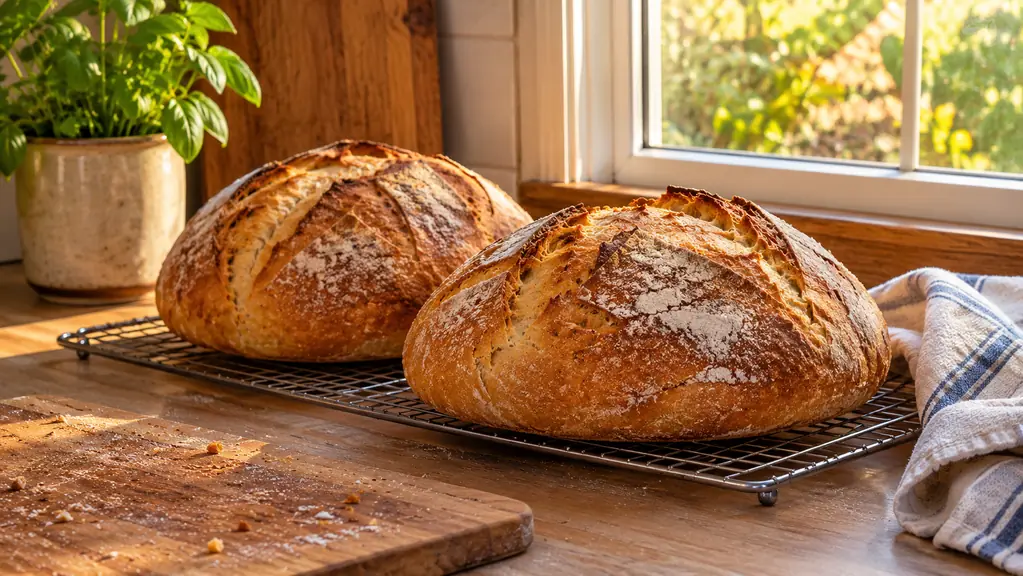
Nothing has failed. The finish on the housing is unmarked apart from a scuff where I bumped it with a saucepan. The bowl handle is still tight. The coated flat beater and the coated dough hook show no coating loss, though I wash all of them by hand because it is quicker than rearranging the dishwasher. The six wire whip has kept its shape, which is more than I can say for the one that came with my hand mixer. The speed knob still clicks through its ten positions cleanly, and the head still locks down with the same firm click it had in March.
The things I would change are mostly small, and one of them is not small. The small things: the machine is loud above speed six, and the head sits high enough that it blocks the light from my window when I am working on the counter beside it. The not small thing is the warranty. One year limited is short for an appliance this heavy that is built to be repaired rather than thrown out. It is the one item on my list where I think the company is being stingy, and it is worth knowing before you buy rather than after.
What I Liked
- Ten speeds on a plain knob, including a stir setting that folds flour in without a mess
- Five quart stainless bowl with a handle, big enough for two loaves or three dozen cookies with room left
- The dough hook developed every bread and pizza dough I made, in about eight minutes at a low setting
- 22 pounds on a stable base, so it stays where you put it and does not walk across the counter
- The four tools in the box cover real work, and the six wire whip has held its shape
Where It Falls Short
- Loud at the top speeds, and I would not leave it running unattended
- 22 pounds means it earns permanent counter space or it does not get used at all
- Small batches, like one egg white or a single cup of cream, do not mix well in a five quart bowl
- The tilt head moves slightly under a stiff doubled batch of dough
- One year limited warranty is short for a machine built to last this long
A two loaf batch at 65 percent hydration developed in roughly eight minutes on the dough hook, and the machine never stalled, never smelled hot, and never moved toward the edge of the counter.
Who This Is For
This is for the home cook who makes bread, pizza or cookies on a semi regular basis and wants the mixing to stop being the part that hurts. It suits a two person household that cooks at home and occasionally feeds a crowd, because five quarts covers both without tipping into a commercial size. It suits anyone who would rather turn a knob than read a display and scroll through a menu. If you have been kneading by hand, or fighting a hand mixer that wanders, the jump in capability is immediate and you will notice it on the first loaf. That is the whole reason the KitchenAid stayed on my counter while other things went into cabinets.
Who Should Skip It
Skip it if your baking runs to single servings. A five quart bowl does small batches badly and there is no way around that. Skip it if you have limited upper body strength or no free counter space, because 22 pounds that lives in a cabinet is 22 pounds you will stop lifting by March. Skip it if you regularly make four loaves at once or run a small baking business out of your kitchen, since the bowl and the motor will both be your bottleneck. And skip it if a one year warranty is a deal breaker, because that is a real limitation and I will not talk you out of caring about it.
Eight months in, mine has not moved off the counter
Ten speeds, a five quart stainless bowl and the four tools I actually reach for. If your wrists have started complaining about the kneading, this is the version of the fix that holds up week after week.
Amazon Check Today's Price on Amazon →