
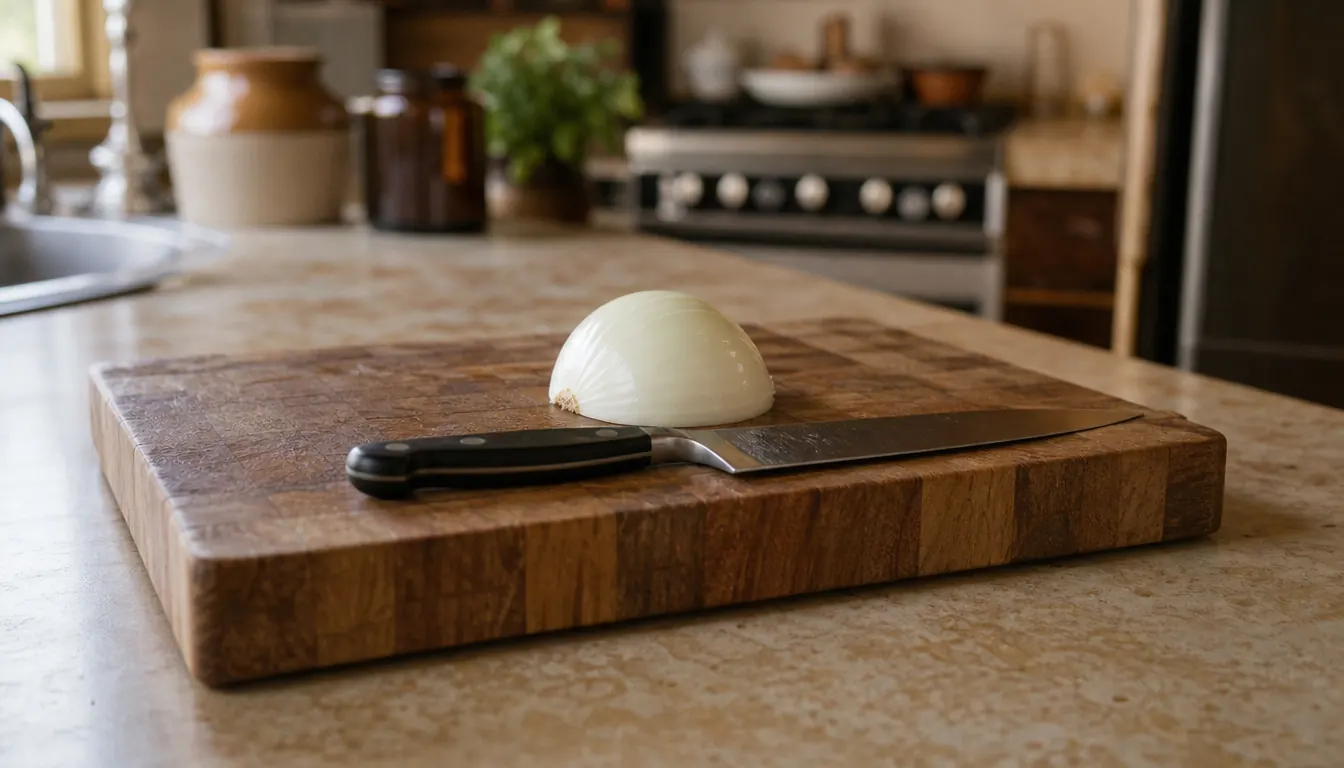
The first onion I tried to dice with a real chef's knife came out in three sizes at once: a few neat cubes, a stack of mangled slabs, and a puddle of juice that turned my cutting board into a skating rink. I had been cooking dinner for more than thirty years by then. I had simply never been taught, so I did what most people do, which is attack it with brute force and blame the onion. The low point came on a Sunday afternoon three years ago, dicing two onions for a pot of chili while the grandkids were in the living room. Halfway through the second one the board was so wet that the onion slid out from under my guide hand and I nicked the side of my thumb. Ruth found the bandage in the sink and asked whether the chili was worth it. Fair question.
What fixed it was not a trick. It was a knife that could actually cut, plus five steps done in the right order. In the first week of March this year I bought a Victorinox Fibrox Pro 8 inch chef's knife and retired the department store block I had owned for about twenty years. Those old knives would not hold an edge no matter how long I worked them, and a dull knife bruises an onion rather than slicing it. Eight months of nearly nightly dinners later, dicing an onion takes me about ninety seconds and the board stays dry. Here is how I do it, and why each step earns its place.
Ninety seconds per onion starts with an edge that actually cuts
The Victorinox Fibrox Pro 8 inch chef's knife is the one I reach for every night. Stamped stainless steel blade, Fibrox handle, dishwasher safe, and a lifetime warranty against manufacturing defects.
Amazon Check Today's Price on Amazon →Why a Sharp Knife Makes an Onion Easier on Your Eyes
A whole onion barely smells. The compounds that sting your eyes are locked in separate compartments inside each cell, and they only meet when you tear the walls between them. Cut into an onion and an enzyme called alliinase gets released and starts converting flavor compounds into sulfenic acids, which break down further into a volatile gas. That gas drifts up to your eyes, dissolves in the moisture there, and turns into a mild sulfuric acid. Your eyes water to flush it out. That is the entire mechanism, and it explains why a badly cut onion makes you cry harder than a well cut one.
This is where the knife matters. A dull edge does not slice so much as crush. It splits cells along a wide ragged path and squeezes juice out ahead of the blade, so you get more torn tissue, more runoff on the board, and more of that gas in the air above it. A sharp edge severs the walls it passes through and leaves the rest of the onion intact. Fewer crushed cells at the surface means less liquid escaping, and less liquid means the pieces hold their shape when they hit the pan instead of steaming in their own juice.
I tried to measure this once, the way a chemistry teacher would. I diced one onion with a knife from the old block and one with the Victorinox, on the same board, on the same afternoon, and collected what ran off the edge into a small dish. The old knife left close to twice as much. One trial is not data and I will not pretend otherwise, but the gap was wide enough that I stopped wondering whether the swap was worth it.
The second reason is control. My old department store knives had thick spines and blunt tips, so I could never feel where the edge was heading. The Victorinox Fibrox Pro has an 8 inch stamped blade that tapers to a fine point, and that taper is what lets me stop a cut exactly where I intend to. I hone it on the steel I already owned about once a week, and I hand wash and dry it right after dinner even though it is listed as dishwasher safe. Eight months in, it still takes the fuzz off my forearm, which is the only sharpness test I trust.
How to Dice an Onion Cleanly, Step by Step
Step 1: Set Up a Board That Cannot Move
Put a damp kitchen towel under your cutting board. That is the whole step, and skipping it is how people cut themselves. My board is a butcher-block slab that weighs a couple of pounds, and even that will creep across laminate counter once onion juice gets underneath it. A wrung-out wet towel kills the slip. Wring it out well, though. You want damp, not dripping, because a board swimming in water is its own hazard.
The one time I skipped the towel, in a hurry to get a pan going, the board crept a full two inches across the counter and took the onion with it. That is not a dangerous failure. It is an annoying one, which is worse, because you do it again the following week and then it becomes a habit.
Then think about the onion itself. Cold onions release less of that volatile gas, so I put mine in the refrigerator for about fifteen minutes before I cut. That is a habit I picked up from Ruth and initially dismissed as fussy, and I was wrong about it. A cold onion is also slightly firmer, so the pieces stay square under the blade instead of collapsing into each other. Fifteen minutes is enough. An hour is not better. I have also tried cutting an onion under a running faucet, which people recommend, and I would not bother. It works about as well as you would expect: water all over the counter, eyes still stinging, onion wetter than it needs to be.
Step 2: Halve It Through the Root, Not the Stem
Lay the onion on its side. The hairy end is the root end. The pointed end is the stem end. Cut off the stem end, maybe half an inch back, and leave the root alone. The root is a handle, a hinge and a set of bristles all at once, and every step after this one depends on it still being attached.
Stand the onion on its flat cut face and cut straight down through the middle, right through the root. You now have two halves with the root holding each one together at one end. Peel the papery skin back from the cut side toward the root. If a layer underneath looks dry or bruised, take that layer too. Leaving it on gives you a tough flap that will not dice and will not soften, and you will find it in the finished dish.
Step 3: Make the Horizontal Cuts First
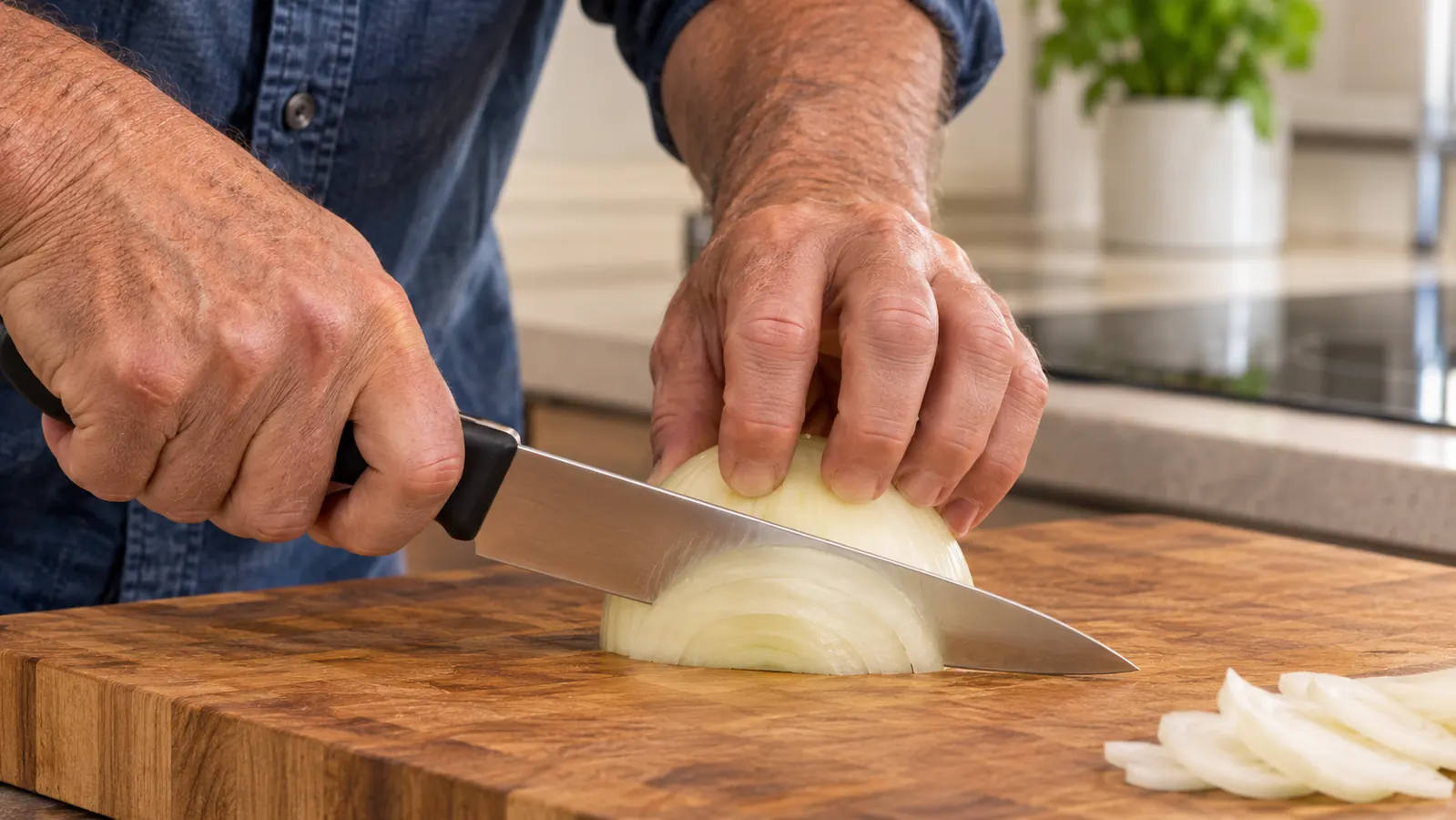
Put a half cut side down on the board with the root pointing away from you. Hold it with your guide hand: fingertips curled under, knuckles forward, thumb tucked behind the onion. Rest the flat of the blade against your knuckles. Now make one or two horizontal cuts parallel to the board, starting about a quarter inch above the surface and working in from the stem end toward the root. Stop short of the root. You are separating layers here, not sawing through the hinge.
The reason to do horizontals first is that once the vertical cuts are in, the onion becomes a stack of loose strips that slide apart the moment you try to lay a knife sideways through them. Do it in the other order and you get a pile of slivers instead of a dice. For these cuts, rest the tip on the board and use a gentle forward and down motion rather than pressing straight down. The 8 inch blade of the Victorinox is long enough to cross a large onion in one pass, which keeps the layers lined up while you work. On a small onion, one horizontal cut is plenty. On the big storage onions I buy in October, two sits better.
Ninety seconds from a whole onion to an even dice, and the board is still dry when I finish. Three years ago it took me five minutes and a puddle.
Step 4: Follow the Curve With the Vertical Cuts
Keep the root pointing away from you. Make vertical cuts straight down through the onion, spaced by however large you want the finished dice. The mistake nearly everyone makes is cutting a perfect grid. An onion is a sphere, not a box. The outer layers curve away from the center, so a rigid grid leaves the outside in fat wedges and the middle in slivers. Aim each cut at the root end and let the blade fan slightly as you move across the curve.
For my first month with the new knife I cut exactly that grid, straight down at even spacing, because a grid is what the diagram in a cookbook looks like. What I got was a decent dice with a handful of fat crescents mixed through it, every one of them from the outer layers. So I started angling. The cuts nearest the curved outside lean in toward the root and the cuts through the middle go straight down. Now the pieces come out the same size from edge to center, and the onion browns evenly in the pan instead of scorching in a few spots.
Keep the tip on the board and rock the blade forward and down rather than chopping straight through. Your guide hand walks back toward the root one knuckle width at a time, and your knuckles stay in contact with the flat of the blade the whole way. Do not lift the knife higher than the top of the onion. Small controlled strokes beat big dramatic ones, and over a whole onion the difference in speed is about ten seconds.
Step 5: Dice From the Root Forward, Tip Down
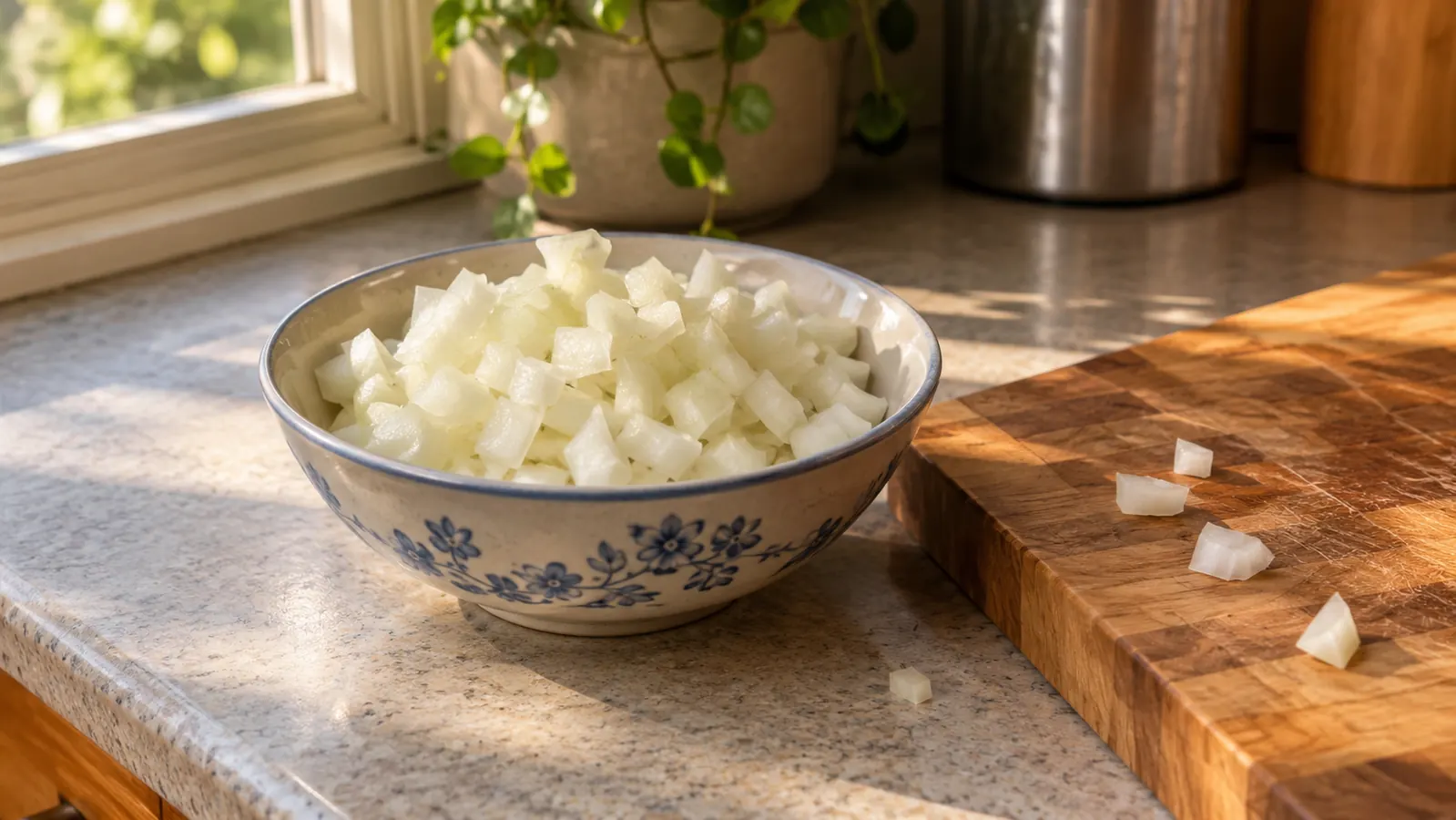
Turn the onion so the root is closest to your knife hand and cut crosswise straight down through the strips, working from the root end toward the tip. The root end is the firmest part and it holds everything together while you work through it. The last inch near the root is the hardest to dice evenly, so I turn that piece on its side, cut it into a couple of slices, and chop those separately. Nobody at the table has ever noticed.
I also rinse my hands in cold water before I start. It does almost nothing for the fumes rising off the board, but onion on your fingertips finds its way to your eyes eventually, usually when you push your glasses up, and cold water takes it off better than warm does. It is a small thing that saves me one good sting per onion.
Scrape the diced onion into a bowl with the back of the blade, not the edge, and wipe the board dry before you start the next one. If you are dicing three onions for a braise, dice them one at a time rather than halving all three up front. A halved onion sitting on the board loses moisture and starts to go limp, and a limp onion dices badly no matter how good your knife is.
What Else Helps
The knife does most of the work, but three small habits cover the rest. First, sharpen properly and less often than you think. Honing weekly just realigns an edge that has rolled, and I have mine properly sharpened twice a year. Second, deal with the air. Turn the range hood on before you start, because it pulls that gas away from your face, and if you are sensitive, work near an open window. Third, keep your dice size matched to the dish. A coarse dice for a braise, a fine one for a pan sauce, and no guilt either way.
I would also tell you not to chase a restaurant finish. A home cook with a decent knife and a dry board will get an onion into the pot in under two minutes, and in a pot of chili an uneven dice disappears in twenty minutes anyway. Where the cut actually shows is in a raw dish, salsa or a salad, and there the fix is a smaller onion and a slower pace, not more talent. The Victorinox carries a lifetime warranty against manufacturing defects, which the knife block in my garage never offered. I wish I had made the swap twenty years ago. The only thing I can say in my own defense is that nobody had ever told me the order of the cuts.
Stop crushing onions with a knife that cannot hold an edge
One 8 inch stamped stainless blade, a Fibrox handle, and a lifetime warranty against manufacturing defects. Mine has handled eight months of nightly dinners and still shaves a forearm.
Amazon Check Today's Price on Amazon →